About 189 minutes
The Outdoor Girls in Army Service; Or, Doing Their Bit for the Soldier Boys — Edition Insights
Classic Adventures
43,438 recorded words. 11 minutes difference from this book's estimate.
View Gutenberg source #7494
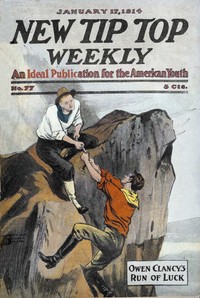
Owen Clancy's Run of Luck; or, The Motor Wizard in the Garage — A Reader’s Guide can be approached with a clearer sense of reading commitment from its source measurements: 40,917 words, 2 hr 58 min estimated reading time, and 24 detected text sections.
The text analysis averages about 13.6 words per sentence, while the detected sections provide another way to judge how the source is divided.
Project Gutenberg metadata also associates the work with “Adventure stories,” connecting these edition facts with the source record’s subject description.
Explore this collection
These alternatives are selected using recorded categories and estimated reading time.
About 189 minutes
Classic Adventures
43,438 recorded words. 11 minutes difference from this book's estimate.
View Gutenberg source #7494About 191 minutes
Classic Adventures
43,805 recorded words. 13 minutes difference from this book's estimate.
View Gutenberg source #62652About 164 minutes
Classic Adventures
37,583 recorded words. 14 minutes difference from this book's estimate.
View Gutenberg source #50654Search stored excerpts and compare books → Choose by your preferences →
Choices use stored catalog measurements. Estimates vary with reading speed. A shared category is a catalog label, not a claim that two books have the same argument or literary quality.
Search reads excerpt text stored with this catalog and links to its associated Gutenberg record. The connection is stored in the site database; this tool does not recheck that every excerpt is word-for-word identical to that external record. Excerpt search does not cover every chapter and does not verify historical publication dates.
Catalog snapshot checked: 2026-09-26. Coverage: 100 public books, 100 available source excerpts.
Calculated from edition completeness, EPUB availability, text structure and catalogue metadata. Not a user rating.
Total of 100 points, scaled to a 2.5-5.0 range. Editions with an empty description or a missing EPUB file are not scored.
Public-domain source text
The source text is kept in the dedicated reader, separate from this catalogue record and its commentary.
The story opens with a startling yell and a body soaring over a cliff: Owen Clancy, tramping along a road, witnesses a man roll over the rim rock. The prose matches the velocity of the event—short exclamations, a gulped oath, and a sudden halt. This dime novel, originally published in New Tip Top Weekly, wastes no time establishing its hero's resourcefulness and the high stakes of its motor-age setting.
Clancy is introduced as a red-headed chap whose every nerve quivers, but he quickly shifts from stunned onlooker to active participant. The narrative voice favors colloquial energy over description, with dialogue carrying much of the plot. The opening chapter, “Over the Rim Rock,” sets a pattern of abrupt crises and quick recoveries that defines the book's pacing.
The narrator adopts a brisk, vernacular tone that matches the dime-novel format. Exclamations like “Great jumping horn toads!” and “by thunder!” punctuate the action, while characters speak in clipped, functional lines. The dialogue often carries exposition: when Clancy meets Hibbard, their exchanges are terse and loaded with threat. The voice rarely lingers on interior states; instead, it reports physical reactions—a quiver, a duck, a lurch forward. This keeps the narrative moving at a clip suited to serial publication.
Standish also uses sound effects sparingly but effectively. The opening “Honk, h-o-n-k!” and the later “yell” create an auditory texture. The prose is lean, favoring verbs over adjectives, which gives the action a cinematic quality. Even when characters explain mechanical problems, the language stays plain: “tampered with the car” is typical of the straightforward speech.
The book alternates between high-velocity action and slower, dialogue-heavy scenes. The opening cliff incident is a blur of motion—soaring, dropping, rolling—followed by Clancy’s halted realization. Later, a night chase through palm trees shifts abruptly to a drawing-room confrontation. The robbery sequence moves from a sprint to a standoff, then to a conversation with Judge Pembroke. These pace changes are signaled by paragraph length: action scenes use short, staccato sentences; explanatory passages use longer, more measured ones.
One notable shift occurs when Clancy, after a struggle, says “I hardly see how you could help it” in a calm tone. The narrative slows to let characters talk, then accelerates again with a new threat. The result is a rhythm of crisis and respite that keeps the reader engaged without monotony.
The story is grounded in a specific technological milieu: automobiles, garages, and roadside breakdowns. Clancy is introduced as a “motor wizard,” and his expertise is demonstrated through practical actions—repairing a car, recognizing tampering. The setting shifts from a dusty road and cliff to the Red Star Garage, then to Judge Pembroke’s house. Each location is sketched with just enough detail to support the action: the “cloud of dust,” the “line of palm trees,” the “front steps.”
Mechanical details are woven into the plot. The robbery hinges on a car being tampered with, and Clancy’s skill is central to resolving conflicts. The narrative treats automobiles as both tools and sources of danger, reflecting the era’s fascination with motor transport. The garage is not just a backdrop but a site of problem-solving, where Clancy’s luck and knowledge intersect.
Readers should pay attention to how Standish uses Clancy’s red hair as a recurring visual marker—it appears in the first chapter and is mentioned again during the chase. The book’s serial origins mean each chapter ends with a hook; the table of contents lists twenty-four chapters, suggesting a steady rhythm of cliffhangers. For those interested in early automotive fiction, this title offers a glimpse into how dime novels adapted new technology into adventure formulas.
There’s a particular steadiness in Owen Clancy’s Run of Luck, the way his hands find certainty amid chaos, that reminds me of another kind of endurance—the patient weight of Four Bells: A Tale of the Caribbean — Background and Themes. Both hold their breath before the tide turns. I’ve shelved them near each other for years, and I like to think they listen.
Use these questions to collect your thoughts before moving on.