About 189 minutes
The Outdoor Girls in Army Service; Or, Doing Their Bit for the Soldier Boys — Edition Insights
Classic Adventures
43,438 recorded words. 2 minutes difference from this book's estimate.
View Gutenberg source #7494
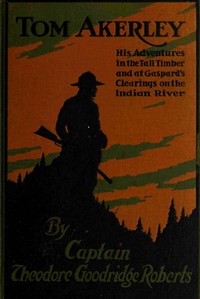
For Tom Akerley His Adventures in the Tall Timber and at Gaspard's Clearing on the Indian River — A Closer Reading, the stored edition analysis reports 43,805 words, 3 hr 11 min estimated reading time, and 17 detected text sections.
The text analysis averages about 15.8 words per sentence, while the detected sections provide another way to judge how the source is divided.
Project Gutenberg metadata also associates the work with “Canada -- Fiction,” connecting these edition facts with the source record’s subject description.
Explore this collection
These alternatives are selected using recorded categories and estimated reading time.
About 189 minutes
Classic Adventures
43,438 recorded words. 2 minutes difference from this book's estimate.
View Gutenberg source #7494About 197 minutes
Classic Adventures
45,293 recorded words. 6 minutes difference from this book's estimate.
View Gutenberg source #30128About 178 minutes
Classic Adventures
40,917 recorded words. 13 minutes difference from this book's estimate.
View Gutenberg source #55463Search stored excerpts and compare books → Choose by your preferences →
Choices use stored catalog measurements. Estimates vary with reading speed. A shared category is a catalog label, not a claim that two books have the same argument or literary quality.
Search reads excerpt text stored with this catalog and links to its associated Gutenberg record. The connection is stored in the site database; this tool does not recheck that every excerpt is word-for-word identical to that external record. Excerpt search does not cover every chapter and does not verify historical publication dates.
Catalog snapshot checked: 2026-09-26. Coverage: 100 public books, 100 available source excerpts.
Calculated from edition completeness, EPUB availability, text structure and catalogue metadata. Not a user rating.
Total of 100 points, scaled to a 2.5-5.0 range. Editions with an empty description or a missing EPUB file are not scored.
Public-domain source text
The source text is kept in the dedicated reader, separate from this catalogue record and its commentary.
The novel opens not in the tall timber of its title but on a hot, hazy night at an aerodrome, with two men in a hut—one leaning back with a cigar, the other stooped over a map. This initial scene, set in the Dominion Air Force, establishes a world of military discipline and covert planning that soon gives way to the isolated clearings and swamps of the Indian River. The transition from hangar to forest is abrupt, and Roberts’s prose shifts accordingly: the office’s “moving light in the black maw of one of the hangars” yields to descriptions of brush-fences, tarpaulins, and moss-chinked cabins. The author’s diction in these early chapters is spare, favoring concrete nouns over adjectives, and dialogue is often clipped—characters speak in short, functional sentences that mirror the practical demands of survival.
Roberts rarely uses dialogue for exposition or character revelation; instead, his characters speak to coordinate tasks, issue warnings, or acknowledge a shared predicament. When Tom thanks Catherine for her plan to signal danger, she replies, “A candle on my window-sill. But that is not all. If the danger seems acute, if there is a chance of people searching the woods for you, I’ll come and warn you.” The exchange is direct, almost transactional, yet the undercurrent of trust is palpable. Later, Mick Otter’s speech is similarly utilitarian: “Do pretty good with ten traps on Racquet,” he says, and Tom’s reply—“I stay right here until something happens”—reveals his stubbornness without a single descriptive clause. This economy of language forces the reader to infer emotion from action and setting rather than from introspection.
Roberts’s descriptions of gear and shelter are precise to the point of being instructional. The camps are built with specific materials: “a lean-to, walled with woven brush and roofed with the tarpaulin”; the Racquet Pond camp is “built of poles chinked with moss—four walls broken by a doorway and a tiny window-hole.” The hearth is “circular,” the roof hole “square.” These details do more than establish setting—they anchor the narrative in the physical labor of survival. When Tom hoists his “lumpy pack” or borrows a kettle and frying pan, the objects carry narrative weight. The bear’s grease, mentioned in an illustration caption, is described as “potent as it smelt,” a sensory detail that grounds the story in the olfactory and tactile realities of bush life.
The weather in the excerpts is not mere backdrop but an active force that shapes the characters’ decisions. The last week of October brings “heavy frost,” “chilly rain,” and even hail—conditions that drive Mick to relocate to the warmer Racquet Pond camp. Tom, however, refuses to move, and his stubbornness is framed by the weather: “Bad as the weather was, Tom immediately set out for the clearings, to borrow another pan and another kettle.” The cold and rain are described with clinical specificity (“rain so exceedingly chilly that it sometimes fell in the form of hail”), and they dictate the rhythm of trapping, visiting, and waiting. Roberts uses weather to externalize the internal tension between Tom’s desire to stay put and the necessity of movement.
Roberts often lets silence carry meaning. In one scene, Gaspard sits “silent for nearly an hour” while Tom and Catherine play chess. When Tom asks about his silence, Gaspard replies, “An’ thinkin’ all the more, lad,” and then speaks of “human vanity an’ ignorance an’ the hand o’ Providence.” The old man’s gaze is described as “searching,” and Tom catches him looking “with an expression of new interest, curiosity and wonder.” The narrative does not explain what Gaspard is thinking; it merely records his silence and his cryptic remark. This restraint is characteristic of Roberts’s method: he presents observable behavior—a glance, a pause, a shift in posture—and leaves the reader to interpret motive. The result is a story that feels both immediate and enigmatic.
Roberts’s prose rewards attention to the physical world: the chink of moss in a cabin wall, the weight of a pack, the taste of rain. Readers who approach this novel as a study in how people speak and move through a landscape will find its spare style a strength. The excerpts offer no resolution to Tom’s flight, but they establish a world where every object and every word carries consequence.
There were moments in Tom Akerley when the stillness of the woods felt like a held breath, a man deciding whether to stay or vanish. That same quiet tension, the weight of a landscape hiding a history of upheaval, drifted back to me later while flipping through The Indian Chief: The Story of a Revolution — Edition Insights. Both feel like whispers from a campfire at dusk, never quite saying everything aloud.
Create a short personal record of your experience with this book.