About 160 minutes
In the Depths of the Dark Continent; or, The Vengeance of Van Vincent — Background and Themes
Classic Adventures
36,705 recorded words. 4 minutes difference from this book's estimate.
View Gutenberg source #43353
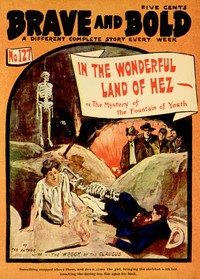
For In the Wonderful Land of Hez; or, The Mystery of the Fountain of Youth — Reading Companion, the stored edition analysis reports 37,583 words, 2 hr 44 min estimated reading time, and 27 detected text sections.
The text analysis averages about 17.1 words per sentence, while the detected sections provide another way to judge how the source is divided.
Project Gutenberg metadata also associates the work with “Adventure stories,” connecting these edition facts with the source record’s subject description.
Explore this collection
These alternatives are selected using recorded categories and estimated reading time.
About 160 minutes
Classic Adventures
36,705 recorded words. 4 minutes difference from this book's estimate.
View Gutenberg source #43353About 153 minutes
Classic Adventures
34,982 recorded words. 11 minutes difference from this book's estimate.
View Gutenberg source #5602About 151 minutes
Classic Adventures
34,713 recorded words. 13 minutes difference from this book's estimate.
View Gutenberg source #65833Search stored excerpts and compare books → Choose by your preferences →
Choices use stored catalog measurements. Estimates vary with reading speed. A shared category is a catalog label, not a claim that two books have the same argument or literary quality.
Search reads excerpt text stored with this catalog and links to its associated Gutenberg record. The connection is stored in the site database; this tool does not recheck that every excerpt is word-for-word identical to that external record. Excerpt search does not cover every chapter and does not verify historical publication dates.
Catalog snapshot checked: 2026-09-26. Coverage: 100 public books, 100 available source excerpts.
Calculated from edition completeness, EPUB availability, text structure and catalogue metadata. Not a user rating.
Total of 100 points, scaled to a 2.5-5.0 range. Editions with an empty description or a missing EPUB file are not scored.
Public-domain source text
The source text is kept in the dedicated reader, separate from this catalogue record and its commentary.
Cornelius Shea opens In the Wonderful Land of Hez with a deliberately outsized character portrait: Professor Remington Easy wears “blue goggles of extraordinary proportions” that make him look like he has “donned a diver’s helmet.” The narrator’s voice is breezy and direct, introducing the professor as “short and very stout” and his companion as “a tall, la” before cutting off mid-word. This abrupt truncation—likely a typesetting quirk—nonetheless signals the serial’s breathless, episodic rhythm. Shea leans on physical exaggeration and quick scene-setting to hook readers, a hallmark of the dime-novel style.
Shea’s character introductions rely on broad, almost cartoonish physical traits. Professor Easy is defined by his “blue goggles of extraordinary proportions” and his “round, smooth-shaven face,” which instantly signals good nature. The narrator does not trust readers to infer; instead, he states plainly: “one look at his round, smooth-shaven face would have told the casual observer that he was a good-hearted individual.” This technique reduces character interiority to external markers. Later, Azurma’s swooning and her declaration “I have found you, O my future lord and master!” lean on melodramatic gesture rather than psychological depth. The prose favors immediate visual cues over subtle motivation, keeping the action moving at the expense of nuance.
Dialogue in the excerpts functions less as conversation and more as a vehicle for plot advancement and emotional shorthand. When Leo rescues Azurma from a picuasus, she responds with a formal, almost ritualistic line: “I have found you, O my future lord and master!” Leo immediately cuts her off: “Call me Leo; don’t use any more high-fangled titles—I don’t like it.” This exchange establishes hierarchy and personality in a few words. Similarly, Reginald Lacy’s desperate “God bless you, my girl!” and his concern for his dog Jupiter (“But my dog must have something, too”) reveal character through action-oriented speech. Shea avoids lengthy introspection; characters speak to declare intentions, express immediate needs, or react to peril.
The Florida Everglades serve as more than backdrop—they are an active source of danger. Shea populates the landscape with specific threats: the “picuasus” (a fictional predator), a rushing stream that sweeps Lacy toward a waterfall, and the constant possibility of being lost. The setting forces characters into reactive, survival-driven choices. When Lacy and his dog Jupiter are carried “further and further” toward the falls, the narrator emphasizes helplessness: “Leo was completely dismayed. The very ones who had saved his life were now going to their own death.” The environment dictates the plot’s rhythm, with each new location—the stream, the village, the palace—introducing fresh obstacles. Shea’s descriptive language is functional, focusing on movement and threat rather than atmosphere.
The chapter titles reveal a serialized structure built on escalating crises: “The Dance of Death,” “The Devil’s Kingdom,” “In the Bowels of the Earth.” Each chapter ends with a moment of high tension, such as Lacy and Jupiter “whirling over the cataract with a mighty rush.” Shea uses short paragraphs and rapid scene shifts to maintain momentum. The narrator occasionally interjects with direct addresses (“as brave as she was, Azurma had swooned”), but the overall pace is driven by action verbs and immediate consequences. This serial format prioritizes cliffhangers over resolution, encouraging readers to continue to the next installment. The episodic nature is reinforced by the weekly publication schedule of Brave & Bold.
Readers approaching In the Wonderful Land of Hez should expect a fast-paced, visually driven narrative where character is revealed through action and dialogue rather than interior reflection. Shea’s dime-novel style rewards attention to how he builds suspense through physical description and abrupt chapter endings. The Everglades setting is not merely decorative but a central engine of conflict. Treat each chapter as a self-contained episode within a larger adventure serial.
The rain drummed on the windowsill as I turned the last pages of the Hez guide, lingering on its hurried, breathless dialogue. It made me think of how a plea can sound like a command, which is how I found myself, an hour later, with At the Queen's Mercy — A Reader’s Guide. Some stories just whisper about others, quietly, in the gaps between the storm and the lamplight.
Capture what you thought, learned, and would like to remember.