About 235 minutes
Daughters of Destiny — Story, Setting & Ideas
Classic Adventures
54,039 recorded words. 1 minutes difference from this book's estimate.
View Gutenberg source #54540
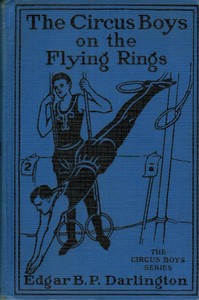
The catalog record for The Circus Boys on the Flying Rings; Or, Making the Start in the Sawdust Life — Inside the Classic provides practical reading context through 53,812 words, 3 hr 54 min estimated reading time, and 25 detected text sections.
The text analysis averages about 12.8 words per sentence, while the detected sections provide another way to judge how the source is divided.
Project Gutenberg metadata also associates the work with “Adventure stories,” connecting these edition facts with the source record’s subject description.
Explore this collection
These alternatives are selected using recorded categories and estimated reading time.
About 235 minutes
Classic Adventures
54,039 recorded words. 1 minutes difference from this book's estimate.
View Gutenberg source #54540About 238 minutes
Classic Adventures
54,518 recorded words. 4 minutes difference from this book's estimate.
View Gutenberg source #41962About 226 minutes
Classic Adventures
51,943 recorded words. 8 minutes difference from this book's estimate.
View Gutenberg source #2476Search stored excerpts and compare books → Choose by your preferences →
Choices use stored catalog measurements. Estimates vary with reading speed. A shared category is a catalog label, not a claim that two books have the same argument or literary quality.
Search reads excerpt text stored with this catalog and links to its associated Gutenberg record. The connection is stored in the site database; this tool does not recheck that every excerpt is word-for-word identical to that external record. Excerpt search does not cover every chapter and does not verify historical publication dates.
Catalog snapshot checked: 2026-09-26. Coverage: 100 public books, 100 available source excerpts.
Calculated from edition completeness, EPUB availability, text structure and catalogue metadata. Not a user rating.
Total of 100 points, scaled to a 2.5-5.0 range. Editions with an empty description or a missing EPUB file are not scored.
Public-domain source text
The source text is kept in the dedicated reader, separate from this catalogue record and its commentary.
The story begins not under canvas but on a street before a billboard, where two boys debate the difference between a cartwheel and a double somersault. Phil Forrest, the more serious of the pair, confesses he would like to be “something up in the air—high up near the peak of the tent.” Teddy Tucker, by contrast, imagines cracking a whip as ringmaster or making people laugh as a clown. Their exchange establishes a clear contrast in temperament: Phil is measured and aspirational, Teddy impulsive and practical. Within a few pages, both are plunged into the actual circus lot, where they discover that the sawdust life begins not with applause but with shivering in the dark, falling into a stream, and begging for coffee from a kind showman. The early chapters thus ground the boys’ romantic notions in immediate physical discomfort.
The opening chapter introduces Phil and Teddy through their reactions to a circus poster. Phil’s eyes glow as he imagines flying through the air “all dressed in pink and spangles,” while Teddy matter-of-factly declares he will be a circus man “someday.” Their dialogue reveals distinct voices: Phil uses phrases like “I’d be willing to try it, though, if I had something below to catch me,” showing caution even in fantasy; Teddy answers with short, confident statements such as “Uh-huh!” and “Going to be.” The author sustains this contrast in later excerpts. When the boys fall into a stream, Phil immediately proposes running to warm up, while Teddy groans and wishes he were home. Phil’s instinct is to solve problems; Teddy’s is to complain. Yet both share a stubborn attraction to the circus, which keeps them moving forward despite cold and hunger.
The middle excerpts show the boys’ first morning on the lot. They are cold, wet, and lost in the dark field. The language shifts from the eager tone of the poster scene to short, shivering lines: “B-r-r-r!” and “T-h-h-h-at’s what I say.” The author uses physical detail to convey the reality of tent life: the ground gives way underfoot, the water is icy, and the men they ask for directions are often gruff. One worker tells them to “get a compass.” But a cheerful cook offers coffee, and the boys drink two cups each. Phil warns Teddy not to drink more because it will make them too nervous to work. This small moment shows Phil already thinking ahead, a trait that will serve him as he navigates the show’s hierarchy. The excerpts do not reveal whether the boys secure jobs, but the pattern of discomfort followed by small kindnesses suggests the circus world is harsh but not heartless.
The narrative voice is direct and action-oriented, with dialogue carrying much of the characterization. Chapter titles such as “The Lure of the Circus” and “Making His Start in the World” telegraph the plot’s arc without giving away specifics. The author frequently uses exclamations and dashes to mimic excited speech: “My, you’ve got it bad, haven’t you?” and “I—I wish they would send us home now.” This punctuation choice keeps the pace brisk and the emotions immediate. The setting is rendered through sensory details—the dark field, the silent wagons, the sudden cold water—rather than lengthy description. Readers learn the layout of the lot only as the boys stumble through it. This technique aligns the reader’s knowledge with the protagonists’, creating a sense of discovery. The excerpts do not include any circus performances; the focus remains on the behind-the-scenes labor that precedes the show.
The provided text ends before the boys are assigned roles or meet the show’s key figures. It is unclear whether Phil’s aerial ambitions will be realized or whether Teddy will find a place as a clown or ringmaster. The chapter list hints at later developments: “Proving His Mettle,” “Making Friends with the Elephants,” and “A Thrilling Rescue.” These titles suggest that both boys will face tests of courage and that elephants play a significant part. The excerpts also do not reveal the boys’ ages, family backgrounds, or how they came to be on the lot without adult supervision. Readers must infer from the dialogue that they are old enough to travel but young enough to be dismissed as “kids” by the canvasman. The story’s middle and later sections likely fill in these gaps, but the opening establishes a clear trajectory from dream to gritty reality.
Readers approaching this book for the first time should pay attention to the small details of circus work—the cold, the coffee, the gruff and kind workers—because these ground the adventure in a believable world. The contrast between Phil’s steady problem-solving and Teddy’s impulsive complaints is established early and likely drives much of the plot. The chapter titles offer a reliable map of coming events, but the real interest lies in how the boys earn their place in the sawdust life, one chilly morning at a time.
There’s something tender about how Phil and Teddy begin with such bright, separate dreams, only to find the sawdust life takes its own tender hold. It reminds me of another kind of starting over, quieter but no less real, in A Prince to Order — Inside the Classic, where identity gets rearranged, gently, by circumstance. I still think of those cold, wet mornings and how they made the warmth later mean more.
Save your reaction, strongest insight, and memorable passage.