1


Robinson Crusoe — in Words of One Syllable — Reading Companion
(9 User reviews)
2571
Project Gutenberg
2004
Shipwreck survival -- Fiction; Crusoe, Robinson (Fictitious character) -- Fiction; Adventure stories
Readers of public-domain and historical texts
Project Gutenberg digital edition
en
Edition facts
Words: 30,600
Reading time: 134 min
Text sections: 3
Source:
Project Gutenberg record #6936
Lucy Aikin's adaptation of Defoe's classic into words of one syllable, preserving the shipwreck, island life, and Crusoe's encounter with Friday, while adding a preface explaining the novel pedagogical approach.
Editorial Edition Score
4.5/5
★★★★★
★★★★★
Calculated from edition completeness, EPUB availability, text structure and catalogue metadata. Not a user rating.
Edition quality
Read the Text
There were wild beasts here, but I had no gun to shoot them with, or to keep me from their jaws. I had but a knife and a pipe. It now grew dark; and where was I to go for the night? I thought the top of some high tree would be a good place to keep me out of harm's way; and that there I might sit and think of death, for, as yet, I had no hopes of life. Well, I went to my tree, and made a kind of nest to sleep in. Then I cut a stick to keep off the beasts of prey, in case they should come, and fell to sleep just as if the branch I lay on had been a bed of down.
When I woke up it was broad day; the sky too was clear and the sea calm. But I saw from the top of the tree that in the night the ship had left the bank of sand, and lay but a mile from me; while the boat was on the beach, two miles on my right. I went some way down by the shore, to get to the boat; but an arm of the sea, half a mile broad, kept me from it. At noon, the tide went a long way out, so that I could get near the ship; and here I found that if we had but made up our minds to stay on board, we should all have been safe.
I shed tears at the thought, for I could not help it; yet, as there was no use in that, it struck me that the best thing for me to do was to swim to the ship. I soon threw off my clothes, took to the sea, and swam up to the wreck. But how was I to get on deck? I had swam twice round the ship, when a piece of rope, caught my eye, which hung down from her side so low, that at first the waves hid it. By the help of this rope I got on board. I found that there was a bulge in the ship, and that she had sprung a leak. You may be sure that my first thought was to look round for some food, and I soon made my way to the bin, where the bread was kept, and ate some of it as I went to and fro, for there was no time to lose. There was, too, some rum, of which I took a good draught, and this gave me heart. What I stood most in need of, was a boat to take the goods to shore. But it was vain to wish for that which could not be had; and as there were some spare yards in the ship, two or three large planks of wood, and a spare mast or two, I fell to work with these, to make a raft.
I put four spars side by side, and laid short bits of plank on them, cross ways, to make my raft strong. Though these planks would bear my own weight, they were too slight to bear much of my freight. So I took a saw which was on board, and cut a mast in three lengths, and these gave great strength to the raft. I found some bread and rice, a Dutch cheese, and some dry goat's flesh. There had been some wheat, but the rats had got at it, and it was all gone.
My next task was to screen my goods from the spray of the sea; and it did not take me long to do this, for there were three large chests on board which held all, and these I put on the raft. When the high tide came up it took off my coat and shirt, which I had left on the shore; but there were some fresh clothes in the ship.
"See here is a prize!" said I, out loud, (though there were none to hear me), "now I shall not starve." For I found four large guns. But how was my raft to be got to land? I had no sail, no oars; and a gust of wind would make all my store slide off. Yet there were three things which I was glad of; a calm sea, a tide which set in to the shore, and a slight breeze to blow me there.
I had the good luck to find some oars in a part of the ship, in which I had made no search till now. With these I put to sea, and for half a mile my raft went well; but soon I found it drove to one side. At length I saw a creek, to which, with some toil, I took my raft; and now the beach was so near, that I felt my oar touch the ground.
Here I had well nigh lost my freight, for the shore lay on a slope, so that there was no place to land on, save where one end of the raft would lie so high, and one end so low, that all my goods would fall off. To wait till the tide came up was all that could be done. So when the sea was a foot deep, I thrust the raft on a flat piece of ground, to moor her there, and stuck my two oars in the sand, one on each side of the raft. Thus I let her lie till the ebb of the tide, and when it went down, she was left safe on land with all her freight.
I saw that there were birds on the isle, and I shot one of them. Mine must have been the first gun that had been heard there since the world was made; for at the sound of it, whole flocks of birds flew up, with loud cries, from all parts of the wood. The shape of the beak of the one I shot was like that of a hawk, but the claws were not so large.
I now went back to my raft to land my stores, and this took up the rest of the day. What to do at night I knew not, nor where to find a safe place to land my stores on. I did not like to lie down on the ground, for fear of beasts of prey, as well as snakes, but there was no cause for these fears, as I have since found. I put the chests and boards round me as well as I could, and made a kind of hut for the night.
As there was still a great store of things left in the ship, which would be of use to me, I thought that I ought to bring them to land at once; for I knew that the first storm would break up the ship. So I went on board, and took good care this time not to load my raft too much.
The first thing, I sought for was the tool chest; and in it were some bags of nails, spikes, saws, knives, and such things: but best of all I found a stone to grind my tools on. There were two or three flasks, some large bags of shot, and a roll of lead; but this last I had not the strength to hoist up to the ship's side, so as to get it on my raft. There were some spare sails too which I brought to shore.
I had some fear lest my stores might be run off with by beasts of prey, if not by men; but I found all safe and sound when I went back, and no one had come there but a wild cat, which sat on one of the chests. When I came up I held my gun at her, but as she did not know what a gun was, this did not rouse her. She ate a piece of dry goat's flesh, and then took her leave.
Now that I had two freights of goods at hand, I made a tent with the ship's sails, to stow them in, and cut the poles for it from the wood. I now took all the things out of the casks and chests, and put the casks in piles round the tent, to give it strength; and when this was done, I shut up the door with the boards, spread one of the beds (which I had brought from the ship) on the ground, laid two guns close to my head, and went to bed for the first time. I slept all night, for I was much in need of rest.
The next day I was sad and sick at heart, for I felt how dull it was to be thus cut off from all the rest of the world. I had no great wish for work: but there was too much to be done for me to dwell long on my sad lot. Each day as it came, I went off to the wreck to fetch more things; and I brought back as much as the raft would hold. One day I had put too great a load on the raft, which made it sink down on one side, so that the goods were lost in the sea; but at this I did not fret, as the chief part of the freight was some rope, which would not have been of much use to me.
The twelve days that I had been in the isle were spent in this way, and I had brought to land all that one pair of hands could lift; though if the sea had been still calm, I might have brought the whole ship, piece by piece.
The last time I swam to the wreck, the wind blew so hard, that I made up my mind to go on board next time at low tide. I found some tea and some gold coin; but as to the gold, it made me laugh to look at it. "O drug!" said I, "Thou art of no use to me! I care not to save thee. Stay where thou art, till the ship go down, then go thou with it!"
Still, I thought I might as well just take it; so I put it in a piece of the sail, and threw it on deck that I might place it on the raft. Bye-and-bye, the wind blew from the shore, so I had to swim back with all speed; for I knew that at the turn of the tide, I should find it hard work to get to land at all. But in spite of the high wind, I came to my home all safe. At dawn of day I put my head out, and cast my eyes on the sea. When lo! no ship was there!
This change in the face of things, and the loss of such a friend, quite struck me down. Yet I was glad to think that I had brought to shore all that could be of use to me. I had now to look out for some spot where I could make my home. Half way up a hill there was a small plain, four or five score feet long, and twice as broad; and as it had a full view of the sea, I thought that it would be a good place for my house.
I first dug a trench round a space which took in twelve yards; and in this I drove two rows of stakes, till they stood firm like piles, five and a half feet from the ground. I made the stakes close and tight with bits of rope; and put small sticks on the top of them in the shape of spikes. This made so strong a fence that no man or beast could get in.
The door of my house was on the top, and I had to climb up to it by steps, which I took in with me, so that no one else might come up by the same way. Close to the back of the house stood a high rock, in which I made a cave, and laid all the earth that I had dug out of it round my house, to the height of a foot and a half. I had to go out once a day in search of food. The first time, I saw some goats, but they were too shy and swift of foot, to let me get near them.
At last I lay in wait for them close to their own haunts. If they saw me in the vale, though they might be on high ground, they would run off, wild with fear; but if they were in the vale, and I on high ground, they took no heed of me. The first goat I shot had a kid by her side, and when the old one fell, the kid stood near her, till I took her off on my back, and then the young one ran by my side. I put down the goat, and brought the kid home to tame it; but as it was too young to feed, I had to kill it.
At first I thought that, for the lack of pen and ink, I should lose all note of time; so I made a large post, in the shape of a cross, on which I cut these words, "I came on these shores on the 8th day of June, in the year 1659" On the side of this post I made a notch each day as it came, and this I kept up till the last.
I have not yet said a word of my four pets, which were two cats, a dog, and a bird. You may guess how fond I was of them, for they were all the friends left to me. I brought the dog and two cats from the ship. The dog would fetch things for me at all times, and by his bark, his whine, his growl, and his tricks, he would all but talk to me; yet he could not give me thought for thought.
If I could but have had some one near me to find fault with, or to find fault with me, what a treat it would have been! Now that I had brought ink from the ship, I wrote down a sketch of each day as it came; not so much to leave to those who might read it, when I was dead and gone, as to get rid of my own thoughts, and draw me from the fears which all day long dwelt on my mind, till my head would ache with the weight of them.
I was a long way out of the course of ships: and oh, how dull it was to be cast on this lone spot with no one to love, no one to make me laugh, no one to make me weep, no one to make me think. It was dull to roam, day by day, from the wood to the shore; and from the shore back to the wood, and feed on my own thoughts all the while.
So much for the sad view of my case; but like most things it had a bright side as well as a dark one. For here was I safe on land, while all the rest of the ship's crew were lost. Well, thought I, God who shapes our ways, and led me by the hand then, can save me from this state now, or send some one to be with me; true, I am cast on a rough and rude part of the globe, but there are no beasts of prey on it to kill or hurt me. God has sent the ship so near to me, that I have got from it all things to meet my wants for the rest of my days. Let life be what it may, there is sure to be much to thank God for; and I soon gave up all dull thoughts, and did not so much as look out for a sail.
My goods from the wreck had been in the cave for more than ten months; and it was time now to put them right, as they took up all the space, and left me no room to turn in: so I made my small cave a large one, and dug it out a long way back in the sand rock. Then I brought the mouth of it up to the fence, and so made a back way to my house. This done, I put shelves on each side, to hold my goods, which made my cave look like a shop full of stores. To make these shelves I cut down a tree, and with the help of a saw, an axe, a plane, and some more tools, I made boards.
A chair, and a desk to write on, came next. I rose in good time, and set to work till noon, then I ate my meal, then I went out with my gun, and to work once more till the sun had set; and then to bed. It took me more than a week to change the shape and size of my cave, but I had made it far too large; for in course of time the earth fell in from the roof; and had I been in it, when this took place, I should have lost my life. I had now to set up posts in my cave, with planks on the top of them, so as to make a roof of wood.
One day, when out with my gun, I shot a wild cat, the skin of which made me a cap; and I found some birds of the dove tribe, which built their nests in the holes of rocks.
I had to go to bed at dusk, till I made a lamp of goat's fat, which I put in a clay dish; and this, with a piece of hemp for a wick, made a good light. As I had found a use for the bag which had held the fowl's food on board ship, I shook out from it the husks of corn. This was just at the time when the great rains fell, and in the course of a month, blades of rice, corn, and rye, sprang up. As time went by, and the grain was ripe, I kept it, and took care to sow it each year; but I could not boast of a crop of wheat, as will be shown bye-and-bye, for three years.
A thing now took place on the isle, which no one could have dreamt of, and which struck me down with fear. It was this--the ground shook with great force, which threw down earth from the rock with a loud crash--once more there was a shock--and now the earth fell from the roof of my cave. The sea did not look the same as it had done, for the shocks were just as strong there as on land. The sway of the earth made me feel sick; and there was a noise and a roar all around me. The same kind of shock came a third time; and when it had gone off, I sat quite still on the ground, for I knew not what to do. Then the clouds grew dark, the wind rose, trees were torn up by the roots, the sea was a mass of foam and froth, and a great part of the isle was laid waste with the storm. I thought that the world had come to an end. In three hours' time all was calm; but rain fell all that night, and a great part of the next day. Now, though quite worn out, I had to move my goods which were in the cave, to some safe place.
I knew that tools would be my first want, and that I should have to grind mine on the stone, as they were blunt and worn with use. But as it took both hands to hold the tool, I could not turn the stone; so I made a wheel by which I could move it with my foot. This was no small task, but I took great pains with it, and at length it was done.
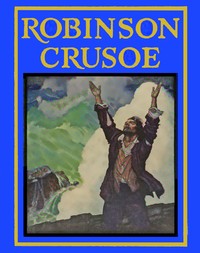
Lucy Aikin's Robinson Crusoe — in Words of One Syllable (credited to Mary Godolphin) is a deliberate linguistic experiment: a retelling of Defoe's novel using almost exclusively monosyllabic words. The preface announces this as a novel construction, aiming to provide connected narrative for young readers beyond the usual spelling-book sentences. The text retains the first-person voice of Crusoe, opening with his birth in York and his early desire for the sea, but the constrained vocabulary forces a stark, compressed style. For instance, the shipwreck is rendered as 'the ship groan in all her planks, and her beams quake from stem to stern'—a vivid image built from simple words. This adaptation does not merely simplify; it reshapes the prose into a rhythmic, almost poetic minimalism.
A Deliberate Constraint: One-Syllable Prose
The most striking feature of this edition is its self-imposed rule: almost every word must be a single syllable. The preface acknowledges exceptions only for proper names like Xury and Friday, and for illustration titles. This constraint produces a distinctive rhythm and forces the adapter to choose concrete, short words. For example, Crusoe's early storm is described: 'the sea was too rough for it to lie near our ship's side, so we threw out a rope, which the men in the boat caught, and made fast.' The vocabulary is limited, yet the action remains clear. This technique mirrors the pedagogical aims of the era, making the text accessible to early readers while preserving the narrative arc. The adaptation does not condense the plot drastically; rather, it translates Defoe's sentences into a new register, often breaking complex ideas into short, declarative clauses.
Friday's Conversion and the Limits of Simplification
The excerpts show that the one-syllable constraint does not prevent the inclusion of theological themes. Crusoe instructs Friday about God, saying 'God dwells there. He made the world, and all things in it.' Friday's response—'O' to Beek—and his subsequent rejection of his former god are rendered in simple dialogue. The text preserves the moment of religious instruction and Friday's emotional reaction: 'he sat still for a long time, then gave a sigh.' However, the simplified language sometimes obscures the original's nuance. Crusoe's fear that Friday might return to his tribe and betray him is expressed in short, blunt sentences: 'It put fears in my mind which made me feel far less at my ease with him.' The adaptation retains the psychological tension but strips away Defoe's more elaborate reflections, leaving a more direct, child-appropriate version of the relationship.
Catalog Subjects vs. Actual Content
The Project Gutenberg catalog lists this work under 'Survival,' 'Shipwreck survival -- Fiction,' and 'Adventure stories.' While the excerpts do include shipwreck and island life, the adaptation's focus is equally on linguistic pedagogy and moral instruction. The preface explicitly states the aim is to provide reading material for 'the youngest readers,' and the text includes extended religious dialogue between Crusoe and Friday. The survival elements—building a boat, finding food—are present but not emphasized in the excerpts. Instead, the conversion scene and Crusoe's internal fears about Friday's loyalty take up significant space. Readers expecting a pure adventure story may find the adaptation's didactic tone surprising. The catalog's secondary topic 'general-literature' is more apt, as the work is as much a literary exercise as a narrative.
Readers should approach this edition not as a substitute for Defoe's original but as a historical artifact of children's literature and language instruction. The one-syllable constraint creates a unique reading experience, where every word is weighed for simplicity. Pay attention to how the adapter handles complex scenes—the shipwreck, the footprint, Friday's conversion—and note where the constraint forces omissions or paraphrases. This version offers a glimpse into 19th-century educational practices and the enduring appeal of Crusoe's story in simplified form.
Carter Lee
2 weeks agoMila Roberts
1 month agoAva Nguyen
2 weeks agoTheodore Lee
4 weeks ago-

Bianca Miller - 4 weeks ago
Robinson Crusoe in Words of One Syllable is a well-intentioned adaptation that succeeds in simplifying the language for early readers. The story is easy to follow, and the essence of the tale remains intact. However, the simplified prose sometimes lacks the descriptive richness of the original, making the survival aspects feel less vivid. The book is a good starting point for kids, but parents might want to also introduce the original for a fuller experience. -
Frank Johnson - 1 week ago
The idea of retelling Robinson Crusoe for children sounds good, but this execution is disappointing. The one-syllable constraint leads to stilted sentences and a dull narrative. The story is stripped of all nuance, and the characters are flat. The pacing is rushed, with major events glossed over. It feels more like a summary than a retelling, and it doesn't capture the spirit of the original. There are better children's versions available. -
Alejandro Sanders - 1 week ago
This version of Robinson Crusoe is a delightful introduction to the classic for young readers. The use of one-syllable words makes it accessible without losing the charm of the original story. The adventures are clearly narrated, and the illustrations enhance the experience. My child loved it, and it sparked an interest in reading more retellings. It's a fantastic way to encourage literacy and a love for adventure.
Reader reflection
Take a moment to reflect on this book
Create a short personal record of your experience with this book.
Your progress
0
/
10
2
Did this book hold your interest?
3
Would you pass this book on to a friend?
4
How easy was the book to follow?
5
Did you gain anything practical from the text?
6
Did the book meet your expectations?
7
How personally connected did you feel to the book?
8
Which part made the strongest impression?
9
What changed or sharpened your thinking?
10



James Allen
3 weeks ago