About 134 minutes
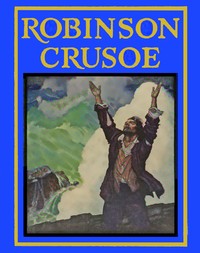
Robinson Crusoe — in Words of One Syllable — Reading Companion
Survival
30,600 recorded words. 25 minutes difference from this book's estimate.
View Gutenberg source #6936

For Wanderers of the Wolf-Moon — Reading Notes, the stored edition analysis reports 25,014 words, 1 hr 49 min estimated reading time, and 3 detected text sections.
The text analysis averages about 11.7 words per sentence, while the detected sections provide another way to judge how the source is divided.
Project Gutenberg metadata also associates the work with “Science fiction,” connecting these edition facts with the source record’s subject description.
Explore this collection
These alternatives are selected using recorded categories and estimated reading time.
About 134 minutes
Survival
30,600 recorded words. 25 minutes difference from this book's estimate.
View Gutenberg source #6936About 246 minutes
Survival
56,444 recorded words. 137 minutes difference from this book's estimate.
View Gutenberg source #12170About 281 minutes
Survival
64,603 recorded words. 172 minutes difference from this book's estimate.
View Gutenberg source #35570Search stored excerpts and compare books → Choose by your preferences →
Choices use stored catalog measurements. Estimates vary with reading speed. A shared category is a catalog label, not a claim that two books have the same argument or literary quality.
Search reads excerpt text stored with this catalog and links to its associated Gutenberg record. The connection is stored in the site database; this tool does not recheck that every excerpt is word-for-word identical to that external record. Excerpt search does not cover every chapter and does not verify historical publication dates.
Catalog snapshot checked: 2026-09-26. Coverage: 100 public books, 100 available source excerpts.
Calculated from edition completeness, EPUB availability, text structure and catalogue metadata. Not a user rating.
Total of 100 points, scaled to a 2.5-5.0 range. Editions with an empty description or a missing EPUB file are not scored.
Public-domain source text
The source text is kept in the dedicated reader, separate from this catalogue record and its commentary.
The first excerpt introduces Gregory Malcolm not through action but through a habitual gesture: he removes his spectacles, breathes on them, wipes them, and replaces them. This small, deliberate motion recurs as a quiet signature, a pause before decision. The narrative voice, meanwhile, shifts between clipped technical jargon—'warp-eddy,' 'super-ionized belt'—and folksy simile: 'as useless as a cow in a cyclone.' The collision of registers establishes a world where book learning and spaceman slang must coexist.
Bond structures the opening as a series of threshold crossings: from radio turret to corridor, from ship to Titan’s surface. Each movement is marked by a door or a hatch, framing survival as a sequence of transitions between enclosed spaces and hostile openness.
Greg’s spectacles appear at three key junctures in the excerpts: when he learns of the vortex, when he negotiates with Breadon, and when he prepares to leave the skiff. Each time the action is identical—remove, breathe, wipe, replace—yet the context changes. The gesture becomes a visual shorthand for composure under pressure. Bond does not explain it; he simply repeats it, trusting the reader to notice the pattern.
The glasses also mark Greg as an outsider. Sparks, the radioman, is described as 'stunted' and 'grinning'; Greg is 'bespectacled' and 'trim.' His hobby is astrogation, a theoretical pursuit. The narrative voice often aligns with Greg’s measured perspective, but it also undercuts him through the reactions of others. When Greg says 'I’ve studied astrogation as few Earthlubbers have,' the boast is undercut by his own admission that he is not a professional spaceman.
The story’s movement is governed by doors. The first excerpt ends with Greg following Sparks to the door of the radio turret. Later, the cave entrance becomes a contested boundary: Breadon’s group is 'open to attack,' while Greg’s group has a 'nice, warm cave.' Aunt Maud’s arrival is announced by a voice from outside, then the door is pulled open to reveal her against the dawn.
Bond uses these thresholds to control information. Inside the cave, the group is safe but isolated; outside, danger and negotiation occur. The skiff, too, is a mobile threshold—a vessel that can be entered or left. When Greg and Sparks leave Breadon’s skiff, Aunt Maud herds them out 'by main force,' turning a diplomatic failure into a physical exit. The repeated emphasis on doors and hatches gives the narrative a stage-like quality, with scenes defined by who is inside and who is outside.
Dialogue in the excerpts is blunt and often interruptive. Sparks speaks in short, colloquial bursts: 'We sit tight and hope.' Greg uses longer, more formal sentences: 'I think I know what we’re up against.' Breadon’s speech is curt and conditional: 'We’ll accept your overtures on one condition.' Aunt Maud, by contrast, uses a warm, commanding tone that cuts through tension: 'Thought you folks might be sort of hungry after a scrap.'
Bond layers these voices to create friction. When Greg offers a reasoned proposal to Breadon, Sparks interrupts with 'No!' and Aunt Maud follows with a bowl of stew. The effect is comic but also structural: each voice represents a different survival strategy—analysis, defiance, and domestic pragmatism. The narrative does not privilege any one of them; instead, it lets them collide.
The excerpts trace a clear spatial divide. Greg’s group occupies a cave; Breadon’s group occupies a skiff. The terrain between them is 'open to attack,' and the journey from one to the other is described in terms of dawn light and hilltops. When Greg and Sparks visit Breadon, they walk 'toward the hill' afterward. When Aunt Maud brings stew, she has 'watched it from the cave.'
This geography reinforces the social split. The cave is associated with warmth, food, and collective safety; the skiff with isolation, upholstered chairs, and dwindling supplies. Bond uses the physical distance to dramatize the ideological distance between Greg’s cooperative model and Breadon’s hierarchical one. The final movement—Aunt Maud herding the men out—suggests that the cave’s domestic order can absorb conflict, while the skiff cannot.
Readers attentive to small physical details—the polishing of spectacles, the opening of a door, the placement of a bowl of stew—will find that Bond builds character and conflict through gesture and setting rather than interior monologue. The excerpts offer no resolution, only a series of thresholds crossed and recrossed. The story’s interest lies less in the outcome of the survival struggle than in the repeated, almost ritualized actions that define each character’s response to crisis.
Malcolm polishing his spectacles on Titan reminds me, quietly, of another solitary man making do with what’s washed ashore. There’s a similar patience in both, a willingness to map the small world you’ve been given, one careful survey at a time. I think of that other guide, The Life and Adventures of Robinson Crusoe — A Reader’s Guide, and how both stories feel less like adventure and more like the long, slow work of staying human.
Use these questions to collect your thoughts before moving on.