About 485 minutes
The Vagrant Duke — Text and Context
Classic Adventures
111,509 recorded words. 0 minutes difference from this book's estimate.
View Gutenberg source #29617
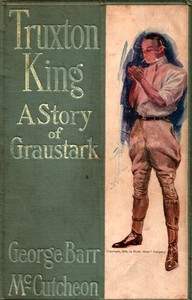
Before opening Truxton King: A Story of Graustark — Inside the Classic, the edition data offers a quick orientation: 111,368 words, 8 hr 5 min estimated reading time, and 10 detected text sections.
The text analysis averages about 13.8 words per sentence, while the detected sections provide another way to judge how the source is divided.
Project Gutenberg metadata also associates the work with “Adventure stories,” connecting these edition facts with the source record’s subject description.
Explore this collection
These alternatives are selected using recorded categories and estimated reading time.
About 485 minutes
Classic Adventures
111,509 recorded words. 0 minutes difference from this book's estimate.
View Gutenberg source #29617About 488 minutes
Classic Adventures
112,209 recorded words. 3 minutes difference from this book's estimate.
View Gutenberg source #33557About 493 minutes
Classic Adventures
113,268 recorded words. 8 minutes difference from this book's estimate.
View Gutenberg source #1401Search stored excerpts and compare books → Choose by your preferences →
Choices use stored catalog measurements. Estimates vary with reading speed. A shared category is a catalog label, not a claim that two books have the same argument or literary quality.
Search reads excerpt text stored with this catalog and links to its associated Gutenberg record. The connection is stored in the site database; this tool does not recheck that every excerpt is word-for-word identical to that external record. Excerpt search does not cover every chapter and does not verify historical publication dates.
Catalog snapshot checked: 2026-09-26. Coverage: 100 public books, 100 available source excerpts.
Calculated from edition completeness, EPUB availability, text structure and catalogue metadata. Not a user rating.
Total of 100 points, scaled to a 2.5-5.0 range. Editions with an empty description or a missing EPUB file are not scored.
Public-domain source text
The source text is kept in the dedicated reader, separate from this catalogue record and its commentary.
Truxton King begins as a young man of leisure, a college athlete turned globe-trotter whose tanned face and loose flannels suggest a life of ease. Yet the novel quickly pivots from this sunlit portrait to a world of locked rooms, whispered plots, and a countdown to assassination. The excerpts show a story built on contrasts: the hero's initial freedom versus his later captivity, the open air of Graustark versus the stifling cellar where he is held. McCutcheon uses sensory details—the feel of leathery skin, the sound of stealthy footsteps—to ground the reader in King's experience, even as the larger political conspiracy unfolds beyond his reach.
The opening chapter introduces Truxton King as a man shaped by college athletics and foreign travel, his clothes fitting loosely but not baggily, his face so weathered it suggests leather. This physical description establishes him as capable but unmoored. By Chapter XI, however, he is bound hand and foot, listening at a door crack as his captors discuss his death. The shift is abrupt: the same man who once searched for Romance now weeps not from fear but from knowledge of the Prince's impending murder. McCutcheon emphasizes this transformation through King's own senses—he distinguishes the difference between footsteps of today and yesterday, noting how the tread grows lighter and more stealthy. The reader is confined with him, sharing his limited perspective and growing dread.
The plot hinges on a fixed date—the 26th—which the conspirators treat as an approaching deadline. King overhears that Tullis has been lured away to the hills of Dawsbergen with a troop of cavalry, a ruse engineered by Count Marlanx. This removal of a key ally is described as a clever stroke, and the conspirators laugh at the joke. The excerpts reveal a network of characters—Peter Brutus, Spantz, Olga Platanova—each with a role in the scheme. Olga, once King's friend and provider of food, is now being groomed upstairs, primed like a gun of war. The language of machinery and fate pervades these passages: King feels the approach of madness, and the conspirators speak of the plot working like a charm. The tension is built not through action but through the steady, inexorable passage of time.
McCutcheon's prose in these excerpts relies heavily on auditory and tactile details to create atmosphere. King lies with his ear to the crack of the door, hearing hushed gatherings and the drawing of bolts. The difference between footsteps of today and those of yesterday is a clue to the mounting strain. When a new prisoner arrives past midnight, the commotion is conveyed through loud commands and the moving of eager footsteps. The setting is almost entirely underground or in locked rooms; the open landscapes of Graustark are absent. This confinement forces the reader to focus on what can be heard and felt—the swollen lips of Peter Brutus from King's blow, the irregular arrival of food, the dead silence before a door is opened. The physical space becomes a character in itself, pressing in on the hero and the reader alike.
Readers approaching Truxton King should attend to the way McCutcheon builds suspense through restriction—of movement, of knowledge, of time. The novel rewards attention to small details: a change in footstep, a missing voice, a laugh that signals a trap. The excerpts offer only a fragment of the larger story, but they reveal a writer skilled at turning a locked room into a stage for psychological pressure.
Reading about Truxton King's idle curiosity colliding with the conspirators' ticking clock, I found myself thinking of another world where time pressures churn—but the air smells of gasoline and grease. There's a similar warmth in watching a bright young man figure things out as he goes, engine sputtering, luck turning. It reminded me, quietly, of Owen Clancy's Run of Luck; or, The Motor Wizard in the Garage — A Reader’s Guide. Both feel like old friends showing off a stubborn, cheerful persistence.
A brief reflection can help important ideas stay with you longer.