About 377 minutes
Son of Power — Reading Companion
Classic Adventures
86,511 recorded words. 12 minutes difference from this book's estimate.
View Gutenberg source #19970
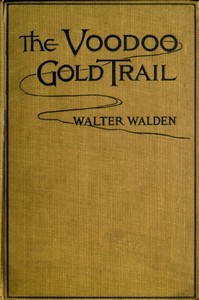
This digital edition of The Voodoo Gold Trail — Story, Setting & Ideas is described by source-level measurements including 83,901 words, 6 hr 5 min estimated reading time, and 8 detected text sections.
The text analysis averages about 15.7 words per sentence, while the detected sections provide another way to judge how the source is divided.
Project Gutenberg metadata also associates the work with “Adventure stories,” connecting these edition facts with the source record’s subject description.
Explore this collection
These alternatives are selected using recorded categories and estimated reading time.
About 377 minutes
Classic Adventures
86,511 recorded words. 12 minutes difference from this book's estimate.
View Gutenberg source #19970About 352 minutes
Classic Adventures
80,787 recorded words. 13 minutes difference from this book's estimate.
View Gutenberg source #6065About 351 minutes
Classic Adventures
80,723 recorded words. 14 minutes difference from this book's estimate.
View Gutenberg source #42742Search stored excerpts and compare books → Choose by your preferences →
Choices use stored catalog measurements. Estimates vary with reading speed. A shared category is a catalog label, not a claim that two books have the same argument or literary quality.
Search reads excerpt text stored with this catalog and links to its associated Gutenberg record. The connection is stored in the site database; this tool does not recheck that every excerpt is word-for-word identical to that external record. Excerpt search does not cover every chapter and does not verify historical publication dates.
Catalog snapshot checked: 2026-09-26. Coverage: 100 public books, 100 available source excerpts.
Calculated from edition completeness, EPUB availability, text structure and catalogue metadata. Not a user rating.
Total of 100 points, scaled to a 2.5-5.0 range. Editions with an empty description or a missing EPUB file are not scored.
Public-domain source text
The source text is kept in the dedicated reader, separate from this catalogue record and its commentary.
Walter Walden's The Voodoo Gold Trail opens with a narrator leaning on a schooner's rail, listening to the sea and overhearing a fragment of a tale from a taciturn guide. The scene establishes a pattern of indirect revelation: the reader learns crucial information through eavesdropped conversations and nested narratives. The guide's straight hair and Indian-like appearance, noted without explanation, hints at a mixed heritage that the story does not immediately clarify. The prose is deliberate, with short declarative sentences punctuated by sensory details—the phosphorescence, the flapping sails, the double stroke of the bell—that ground the adventure in a specific, tangible world.
The excerpts showcase Walden's use of dialect to distinguish characters and signal social or racial positions. Rufe, the black cook, speaks in a thick vernacular: "Dar! You-all—look dar!" and "Oh, Lordy! somebody clap foh me, I jes' got to dance." The guide's speech is not directly quoted in the opening, but his silence is itself a form of characterization—"steadfastly mum"—contrasting with Rufe's effusive outbursts. The treasure-hunters, by contrast, speak in clipped, practical exchanges: "It's a fine night," says Norris, and "Tolerable," returns the leader. This linguistic layering creates a social hierarchy audible in every line, with the white characters using standard English and the black characters rendered in dialect that marks them as comic or servile, a convention of the period.
Walden employs a nested narrative structure. The opening chapter presents a first-person narrator who overhears the guide's tale, but later chapters shift to another character, Wayne, who "takes up the tale." This handoff is explicit: "And here again Wayne takes up the tale." The effect is a layered perspective that distances the reader from direct action, filtering events through multiple consciousnesses. The narrator's role is often that of an observer—"I cocked my ear"—rather than a primary agent. This technique allows Walden to parcel out information gradually, as when the narrator and Robert "fell back, gazing into the shadows" while Norris engages the treasure-hunters in banter. The reader, like the narrator, must piece together the full picture from fragments.
Walden's action sequences are marked by precise, economical description. When Norris fires the brass cannon, the sequence is terse: "There came a flash and a 'Boom!'—and a splash over near the Orion." The response is immediate and physical: "the rattle of the block as the sail was allowed to drop." Similarly, the rescue of Wayne and Ray is rendered through a series of quick, visual cues—a low whistle, a pluck at the sleeve, a scramble into the boat—without internal commentary. The moonlight, the ripples, and the "squeal of a block" provide sensory anchors that keep the scene grounded. Walden avoids melodramatic language, letting the mechanics of the action—the glowing poker, the tarpaulin thrown off, the gun carriage rolled—convey tension.
Throughout the excerpts, light and water function as both setting and signal. The opening paragraph dwells on the "waning moon," the "Milky Way more than commonly near," and the "phosphorescence where the water broke." Later, the "moon was very bright" and the "cocoanut palms stood out distinct." Light is also a plot device: a beacon flashes from shore, and the crew signals back with a lantern. Water is ever-present—the sea purling, the boat moving shoreward, the boys hiding "in the water." These elements are not merely decorative; they create a consistent sensory environment that reinforces the isolation and vulnerability of the characters. The "ripples danced on the waters" before the cannon shot, a moment of deceptive calm before action.
Readers approaching The Voodoo Gold Trail should attend to how Walden parcels out information through dialogue and indirect narration. The story's momentum depends less on continuous action than on the accumulation of overheard scraps, signaled lights, and sudden shifts in perspective. The dialect may feel dated, but it is integral to the novel's social landscape. The treasure hunt itself is often secondary to the process of discovery—both for the characters and for the reader.
That rainy afternoon, I kept returning to the slow, sun-worn cadence of Walden's island voices. His story felt less like a treasure map and more like a tide pulling at forgotten things. The ache of buried histories lingered long after I closed it. Somehow that led me to The Day of Resis — Themes and Context. It held that same quiet weight under different skies—like finding an old coin in another country.
A brief reflection can help important ideas stay with you longer.