1

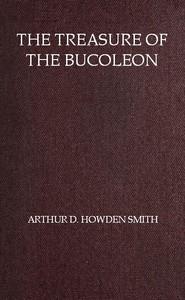
The Treasure of the Bucoleon — Story, Setting & Ideas
(6 User reviews)
1458
Project Gutenberg
2020
Adventure stories; Treasure troves -- Fiction; Constantinople -- Fiction
Readers of public-domain and historical texts
Project Gutenberg digital edition
en
Edition facts
Words: 89,873
Reading time: 391 min
Text sections: 9
Source:
Project Gutenberg record #63353
An editorial note examining Arthur D. Howden Smith's diction, dialogue, and descriptive choices in this adventure novel set in Constantinople, focusing on how the author uses vernacular speech, sensory details, and narrative voice to create atmosphere and character.
Editorial Edition Score
4.8/5
★★★★★
★★★★★
Calculated from edition completeness, EPUB availability, text structure and catalogue metadata. Not a user rating.
Edition quality
Arthur D. Howden Smith's The Treasure of the Bucoleon opens with a cable delivery that sets a brisk, colloquial tone. The narrator, Jack Nash, describes a messenger "peering at the card above the push-button" and a pink envelope that "held the key to destiny." This blend of mundane detail and dramatic foreshadowing characterizes Smith's narrative voice throughout the excerpts. The dialogue is notably casual and idiomatic: Hugh says "Always raggin'" and "I'm about fed up with Wall Street," while Betty King's speech is direct and playful. Smith's diction favors concrete nouns and active verbs, creating a sense of immediacy. The setting shifts quickly from a New York apartment to Constantinople, but the author's focus remains on the characters' interactions and the physical details of their environment, such as the "samovar bubbling in the studio" and the "crescent-shaped street" in the later chase scene.
Dialect and Vernacular in Dialogue
Smith distinguishes his characters through their speech patterns. The narrator Jack uses standard American English, while Hugh's dialogue is peppered with contractions and clipped phrases like "Always raggin'" and "Nobody can make money any more." Betty King's speech is more polished but still informal: "It's very funny." The most striking vernacular appears in the Gypsy characters. The girl's exclamation, "He would have had the other one too if his friend had been as swift. Heh, foster-father, he has the makings of a great thief!" uses a rhythmic, almost poetic syntax. The Old One's response, "Be still, girl! You jabber like a crow," employs a simile grounded in natural observation. Watkins, the hapless victim, speaks in a Cockney-inflected whine: "Oh, Mister Nikka, sir... Not that, sir. There wasn't anything said about me belt, sir." This variety of dialects creates a layered social world without explicit exposition.
Sensory and Physical Description
Smith's descriptive passages emphasize tactile and visual details. The courtyard is "cluttered with bales of goods and boxes" and features "a broken wall, partially built over by a structure of moldy brick." The girl's appearance is rendered in vivid physical terms: "Her hair was a tumbled heap of midnight, and her eyes were great glowing depths of passion. Her shapely legs were bare almost to the knee, and her flimsy bodice scarcely covered her." The chase scene relies on kinetic language: "Hugh sprinted and lunged into Watkins, knocking him against a house-wall" and "Nikka overhauled Watkins and toppled him over with every appearance of ruthless brutality." Smith also uses sound effects sparingly but effectively, such as the knife "whistled down" and the hinge that "creaked." These details ground the action in a palpable reality.
Narrative Voice and Foreshadowing
The first-person narrator, Jack Nash, maintains a wry, self-aware tone. He describes the pink envelope as holding "the key to destiny" and later reflects on his own naivety: "never dreaming that I held the key to destiny in my hand." This technique creates dramatic irony, as the reader knows more than the narrator at the moment of action. Smith also uses the narrator's asides to build suspense. When Jack says, "I wish I was not tied down to an architect's drawing-board," it sets up his eventual departure for Constantinople. The author's choice to have Nikka translate conversations (as noted in a footnote) acknowledges the linguistic barriers within the story, adding a layer of authenticity. The narrative voice remains consistent, blending colloquial observations with moments of heightened emotion, such as when Jack describes the girl's "unconsciously regal air."
Structure of Action and Dialogue
Smith alternates between rapid action sequences and extended dialogue to control pacing. The fight scene with Watkins is a flurry of verbs: "sprinted," "lunged," "overhauled," "toppled," "menaced," "emptied," "ripped." The dialogue that follows is equally brisk, with Watkins's protests and Nikka's terse commands. In contrast, the earlier scene in the studio uses dialogue to convey character relationships and backstory. Uncle Vernon's formal speech about "the upheavals of the war and the occupation of the city by Christian garrisons" contrasts with Hugh's bluntness. Smith also uses the Gypsy girl's dialogue to reveal her admiration for Nikka: "This is the one... he ran like that stallion we had from the Arab of Nejd." The author's structural choices—such as the chapter titles like "The Cable from Hugh's Uncle" and "The Fight in the Gunroom"—signal key plot points while the prose itself focuses on immediate sensory experience.
Readers attentive to Smith's authorial choices will notice how he uses diction to signal class, nationality, and temperament. The contrast between the polished speech of the wealthy uncle and the rough argot of the Gypsies creates a social map of the novel's world. Smith's descriptive style favors the concrete over the abstract, grounding the adventure in physical details. The narrative voice, though first-person, maintains a consistent ironic distance that invites the reader to share in the narrator's discoveries. These elements together shape a story that is as much about the texture of its telling as about the treasure hunt itself.
-

Gloria Warren - 1 week ago
An absolutely riveting historical adventure! The Treasure Of The Bucoleon transports you to the heart of the Byzantine Empire with vivid descriptions and a thrilling treasure hunt. The characters are richly drawn, especially the cunning protagonist whose wit and courage kept me turning pages late into the night. A masterful blend of history and intrigue that left me breathless and craving more. Highly recommended for fans of epic tales! -
Katherine Morgan Martinez - 1 week ago
Unfortunately, The Treasure Of The Bucoleon fails to live up to its promising premise. The writing is often flat, and the dialogue feels stilted, making it hard to connect with any character. The plot relies on coincidence too heavily, and the historical details, while present, are woven in awkwardly. It never manages to build genuine tension or excitement. A disappointing read that might appeal only to the most patient of readers. -
Heather Reyes - 1 week ago
The Treasure Of The Bucoleon offers a solid historical adventure with a decent plot and a likable hero. The author clearly did substantial research, which shines through in the authentic setting. However, the pacing drags in the middle sections, and some secondary characters feel underdeveloped. Still, the climax is satisfying, so it's a reasonable read for historical fiction fans.
Reader reflection
Before you leave, reflect on the book
Use these questions to collect your thoughts before moving on.
Your progress
0
/
10
2
How did the book work for you overall?
3
How likely are you to recommend this book?
4
How much effort did this book require?
5
Would this book work well in a reading group?
6
How strongly did the book affect you emotionally?
7
Did anything about the book feel genuinely new?
8
How clearly were the main ideas presented?
9
What did this book teach you most?
10



Ava Nguyen
1 week ago