1

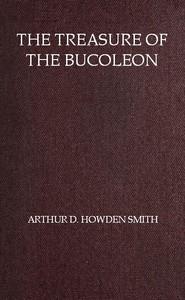
The Treasure of the Bucoleon — Story, Setting & Ideas
(6 User reviews)
1459
Project Gutenberg
2020
Adventure stories; Treasure troves -- Fiction; Constantinople -- Fiction
Readers of public-domain and historical texts
Project Gutenberg digital edition
en
Edition facts
Words: 89,873
Reading time: 391 min
Text sections: 9
Source:
Project Gutenberg record #63353
An editorial note examining Arthur D. Howden Smith's diction, dialogue, and descriptive choices in this adventure novel set in Constantinople, focusing on how the author uses vernacular speech, sensory details, and narrative voice to create atmosphere and character.
Editorial Edition Score
4.8/5
★★★★★
★★★★★
Calculated from edition completeness, EPUB availability, text structure and catalogue metadata. Not a user rating.
Edition quality
Read the Text
I. The Cable from Hugh's Uncle II. The Broken Message III. The Papers in the Charter Chest IV. The Gunroom at Castle Chesby V. A Blind Alley VI. The Hilyer Party VII. The Fight in the Gunroom VIII. The Prior's Vent IX. Hide and Seek X. Stole Away XI. We Split the Scent XII. The Balkan Trail XIII. The Road to Stamboul XIV. The House in Sokaki Masyeri XV. Watkins Plays the Goat XVI. The Red Stone XVII. The Dance in the Courtyard XVIII. The Big Show Begins XIX. First Cruise of the Curlew XX. Out of Luck XXI. Watkins to the Rescue XXII. Hilmi's Friend XXIII. Our Backs to the Wall XXIV. In the Storm XXV. The Reckoning XXVI. Under the Red Stone XXVII. Antiques, Statuary, Chgs. Pd., with Care
The Treasure of the Bucoleon
THE CABLE FROM HUGH'S UNCLE
The messenger was peering at the card above the push-button beside the apartment entrance as I came up the stairs.
"Chesby?" he said laconically, extending a pink envelope.
"He lives here," I answered. "I'll sign for it."
The boy clumped off downstairs, and I let myself in, never dreaming that I held the key to destiny in my hand--or, rather, in the pink envelope.
A samovar was bubbling in the studio, and my cousin Betty King hailed me from the couch on which she sat between her father and Hugh.
"Here you are at last," she cried. "Dad and I have come to say good-by to you."
"What's the matter?" I asked. "Can't you stand Hugh any longer?"
"Always raggin'," he commented.
"We are going to Constantinople to hunt for Greek manuscripts."
"I have a theory," explained my uncle, Vernon King, "that the upheavals of the war and the occupation of the city by Christian garrisons should be productive of rich opportunities for bibliophiles like myself, aside from an enhanced chance for archæological research."
"Well, I wish you luck," I grumbled. "And I wish I was not tied down to an architect's drawing-board."
"'Matter of fact, I'm about fed up with Wall Street," growled Hugh. "Nobody can make money any more."
"It's very funny," remarked Betty. "Both you and Jack announced when you settled down after the war, Hugh, that nothing could ever root you up again. All you wanted, you said, was a good job and plenty of hard work."
"I know it," admitted Hugh. "I remember Nash, here, and Nikka Zaranko--"
"You mean the famous Gypsy violinist?" interrupted my uncle, who, I ought to say, uses the millions he receives from his oil-holdings to patronize the arts and sciences.
"Yes, sir. He was in the Foreign Legion durin' the war. We all met in the last big push in Flanders. I went in with my battalion to help out Jack's crowd, and was snowed under with them. Then Nikka tried to extricate both outfits, and the upshot was the Aussies finally turned the trick. Some show!
"Well, we three became pals. What I was going to say was that the last time we got together before demobilization we agreed we never wanted to feel the threat of danger again. We wanted to become rich and prosperous and fat and contented. That was why I came over to New York with Jack, instead of staying home and fighting with my uncle."
"That reminds me," I said, extending the pink envelope. "Here's a cable for you. Maybe--"
"If it's from Uncle James I shall be surprised," replied Hugh, ripping open the envelope. "A line once in six months is his idea of avuncular correspondence. Hullo!"
He pursed his lips in a prolonged whistle.
"Anything wrong?" asked Betty anxiously.
"No--well--humph! It's hard to say. Listen to this: 'Sailing _Aquitania_ to-day due New York eighteenth must see you immediately have made important discovery your aid essential family fortunes involved this confidential."
"Yes, on second thought, it is wrong, all wrong. He's after that treasure again. Oh, lord! I did my best to persuade him to be sensible before I left England with Jack."
"A treasure!" exclaimed Betty. "But you never told me about it!"
"Oh, it's a long story," protested Hugh. "Frightfully boring. It's a sort of family curse--like leprosy or housemaid's knee. It's supposed to be located in Constantinople, and my uncle has spent his life and most of the family's property trying to find it. That's why I have to make money in New York instead of playing the country gentleman. There was little enough in the family treasury before Uncle James reached it. Now-- Well, the new Lord, who will probably be me, will find trouble paying the Herald's fees, let alone succession duties."
"You really are too exasperating," declared Betty. "A treasure story is never boring."
"I am on Betty's side," said her father.
My uncle Vernon is a very decent sort, despite the fact that he is a millionaire. He is a professor several times over, and hates the title. And he is one of the few learned men I know who can be genuinely interested in low-brow diversions.
"So am I," I said, backing him up. "You have been guilty of secrecy with your friends, which is an English vice I thought I had broken you of, Hugh. Come clean!"
"But there's so little to tell," he said. "I had an ancestor about seven hundred years ago, who is generally called Hugh the First. This Hugh was son to Lord James, who went to the Crusades and was a famous character in his time. On his way to Palestine, the stories say, James stayed a while with the Emperor Andronicus, who ruled in the Eastern Empire--'
"Ah, yes," interrupted King eagerly, "would that have been Andronicus Comnenus, sometimes called The Butcher?"
"Very interesting," nodded King. "Andronicus amassed a great wealth through fines and exactions from the nobles, so the contemporary chronicles tell us."
"And this treasure is supposed to be in Constantinople!" exploded Betty. "Where we are going! Isn't that so, Hugh?"
"Yes, it is always located in Constantinople," answered Hugh. "In fact, it is generally referred to as the Treasure of the Bucoleon, which, I understand from Uncle James and other authorities of my university days, was the principal palace of the Eastern Emperors."
"Quite right," agreed Vernon King, his scholar's interest whipped aflame. "It was a magnificent residence, vying with the Palace of the Cæsars in Rome. In reality, in light of modern antiquarian research, we may describe it as a group of noble structures, standing isolated from the city within a spacious park, surrounded by an independent series of fortifications and with its own naval harbor on the Bosphorus."
"An extensive area to hunt over for an apocryphal treasure," remarked Hugh drily.
"You may well say so," endorsed my uncle. "I have been in Constantinople for extended periods upon several occasions, and I have never satisfied myself as to the existence at this time of any bone fide portions of the Bucoleon, although it is difficult to pronounce definitely on this point. The older portions of the city, especially those most massively constructed, have been so over-built since the Turkish conquest that frequently what is ostensibly a relatively modern building turns out to be almost unbelieveably ancient at the core. But the prejudices of the Turks and their distaste for foreign--"
Betty, chewing her finger with impatience, waved to her father to be silent.
"Daddy!" she exclaimed. "Really, you aren't lecturing, you know! Do let Hugh get on with the treasure."
"But I'm afraid I've gotten as far as I can," replied Hugh. "The tradition simply says that Andronicus confided the secret of the location of the treasure to Lord James. Then Andronicus was assassinated, and James was thrown into prison by his successor. Hugh, James's son, went to Constantinople with an army of Latin Crusaders who had decided that the best way to help the Holy Land was to establish a friendly base there. They conquered the city--"
"A remarkable venture," corroborated my uncle. "The ease with which they secured possession of a city of one million inhabitants, not to speak of an extensive empire, is a clear indication of the degeneracy--"
Betty clapped her hand over his mouth.
"Do get on, Hugh!" she begged. "The treasure! You're almost as long-winded as Dad."
We all laughed, and yet, indefinably, she had communicated to each of us something of the magic spell which is conveyed by any hint of treasure hidden in the past. We savored the heady wine of danger. I felt my right palm itching for the corrugated rubber butt of an automatic. When Hugh continued his story we all leaned forward, flushed and tense.
"The Crusaders captured the city, and Hugh rescued his father. Then they returned to England. Before James died he passed on the secret of the treasure to Hugh. There are documents in the Charter Chest--"
"What's that?" demanded Betty.
"It's a terribly old oaken box, bound with copper and steel," explained Hugh. "We keep it in a safe deposit vault in the City--London, you know. These documents say that James's idea was to have the treasure used for the rehabilitation of Christendom if any cause arose which would justify such a gift. Failing that, the money was to go to his descendants. But for many generations the Lords of Chesby were too busy to hunt treasure so far from home.
"One Lord tried for it in Harry the Fifth's time, but the Greeks watched him so closely that he thought himself lucky to escape from Constantinople with his life. Then the Turks captured the city, and after that it was too risky--except for one chap in Elizabeth's reign. He was Lord James, the sixteenth baron, a shipmate of Raleigh and Drake and Hawkins, and he feared nothing that lived. He put in at Constantinople and bearded the Grand Turk in his lair. But even he did not venture to make a genuine search in view of the conditions that prevailed. From his time on few of the family bothered with the tradition until Uncle James commenced to mortgage farms to finance his researches."
"Then you have no definite knowledge of the location of the treasure?" asked King. "No chart or--"
Hugh laughed bitterly.
"No, sir, that is just why I feel so peevish over the way Uncle James has devastated the estate. It's a search for a needle in a haystack--and a needle that in all probability never existed, at that."
"I fear so," assented King, shaking his head.
"Nonsense!" said Betty. "It's as good a treasure story as I ever read. Why shouldn't it be true? Could you imagine a more perfect place for concealing a treasure all these centuries than Constantinople?"
"Your father will tell you," retorted Hugh scornfully, "that there is not a famous ruin in the Near East but is declared to contain a treasure of one kind or another."
"True--only too true!" agreed King.
"The sole use of the legend so far," continued Hugh unhappily, "has been to give Uncle James something to do. It must be a godsend to Curzon in managing the House, for during the war while Uncle James was shut up in England he was continually moving for the appointment of committees to preserve the monumental brasses of country churches and appealing to the government to recognize that England owed a duty to civilization in retaining and Christianizing Constantinople--so he could dig to his heart's content for the treasure."
"Well, I for one intend to believe in it," stated Betty, "and if your uncle wants any help in hunting for it, he can count on me."
"We'll all help him, if it comes to that," I said. "Nikka Zaranko would never forgive us if we left him out of such a party."
"Uncle James will have nothing tangible to go on," said Hugh. "You can stake your last shilling on that. He's never had a sane idea yet."
"I take it, then," remarked Betty, rising with a detached air, "that you have no desire to go to Constantinople."
Betty is slim, with brown hair and eyes and a face that you have to look at and when she sets her head back-- But of course I am only her cousin. Hugh jumped up, nervously crunching the cable in his hand.
"If I only do get a decent excuse to go to Constantinople!" he exclaimed. "But there's no use. I won't, Bet. I couldn't honestly encourage Uncle James in any more foolishness."
"Perhaps," suggested King, "his visit has nothing to do with the treasure."
Hugh chuckled, his merry self again.
"Cross the Atlantic just to look me up? Not a chance, sir. His ruling passion is driving him on. Confound it, though! I wish this hadn't come up. And I wish I didn't crave adventure again. And I wish you weren't going to Constantinople. All right! Laugh, Jack, curse you! Laugh! Here, I'll scrag you with a couch-pillow!"
"Easy! Easy!" I pleaded. "For the furniture's sake! How about giving the Kings a line to Nikka in Paris or wherever he is?"
"Thanks," said Betty, "but we're going via the Mediterranean. The best thing for you boys to do is to pack up with Hugh's uncle, collect your friend Nikka en route and follow on."
"No go," answered Hugh dismally. "All I am scheduled for is a fat family row."
The steamship company telephoned while Hugh and I were at breakfast to say that the _Aquitania_ was just docking. When we reached the pier West Street was swarming with out-going automobiles loaded with the first contingents of debarking passengers. We pushed our way upstairs into the landing-shed, surrendered our passes and dived into the swirling vortex of harried travelers, hysterical relatives and impassive Custom's officials.
The Purser's office in the Main Saloon was vacant, but Hugh buttonholed a passing steward.
"Lord Chesby, sir? Yes, sir, he was one of the first ashore. There was a gentleman to meet him, I think, sir."
"That's queer," muttered Hugh as we returned to the gangway.
"Our best bet is to go straight to the C space in the Customs lines," I said.
"But who could meet him besides us?" objected Hugh.
"It's damned queer," I agreed. "What does your uncle look like?"
"He's small, stocky, not fat. Must be around sixty," said Hugh vaguely.
We surveyed the space under the letter C, where porters were dumping trunks and bags and passengers were arguing with the inspectors.
"No, he's not here," said Hugh. "Wait, though, there's Watkins!"
"Who's Watkins?" I asked, boring a passage beside him through the crowd.
"He's Uncle James's man."
Watkins was the replica of Hugh's description of his uncle. He was a chunky, solid sort of man, with the masklike face of the trained English servant. He was clean-shaven, and dressed neatly in a dark suit and felt hat. When we came upon him he was sitting forlornly on a pile of baggage, watching the confusion around him. with a disapproving eye.
"Hullo, Watty?" Hugh greeted him. "Where's my uncle?"
The valet's features lighted up, and he scrambled to his feet.
"Ah, Mister Hugh! I'm very glad to see you, sir, if I may say so. "Is ludship, sir? Why, 'e went off with your messenger, sir."
"My messenger?" Hugh repeated blankly.
"Yes, sir, the dark gentleman. Your man, 'e said 'e was, sir."
"My man!" Hugh appealed to me. "Did you hear that, Jack?"
Watkins became suddenly anxious.
"There's nothing wrong, I 'ope, sir? The gentleman came aboard to find us, and told 'is ludship how you'd been delayed, and 'e was to come along to your rooms, sir, whilst I saw the luggage through the Customs. Wasn't that right, sir?"
Hugh sat down on a trunk.
"It's right enough, Watty," he groaned, "except that I never sent such a message and I haven't a man."
"What sort of fellow was this messenger?" I asked.
Watkins turned to me, a look of bewilderment in his face.
"An Eastern-looking gentleman, 'e was, sir, like the Gypsies 'is ludship occasionally 'as down to Chesby. Strange, I thought it, sir, Mister Hugh, that you should be 'aving a gentleman like that to valet you--but as I said to 'is ludship, likely it's not easy to find servants in America."
"How long ago did Uncle James leave, Watty?" asked Hugh.
"Nearly an hour, sir."
"Time enough for him to have reached the apartment. Jack, do you mind telephoning on the off-chance? I'll fetch an inspector to go over this stuff."
I had no difficulty in getting the apartment. The cleaning woman who "did" for us answered. No, nobody had called, and there had been no telephone messages. I hastened back to the C space with a sense of ugly forebodings. Hugh I found colloguing with Watkins, while two Customs men opened the pile of Lord Chesby's baggage.
"Do you know, Jack," said Hugh seriously, "I am beginning to think that something sinister may have happened? Watty tells me that he and Uncle James are just come from Constantinople. He says my uncle went there convinced that he had discovered the key to the treasure's hiding-place, but in some unexplained way Uncle James was deterred from carrying out his plans, and they returned hurriedly to England."
"And now I think of it, sir," amended Watkins, "we 'ave been shadowed ever since we went to Turkey. I never paid much attention to them, considering it was coincidence like, but its been one dark gentleman after another--at the Pera Palace Hotel in Constantinople, on the Orient Express, in London when we called on 'is ludship's solicitors--"
"What was that for?" interrupted Hugh--and to me: "Uncle James hated business. He couldn't be brought to any kind of business interview unless he had a pressing motive."
"Why, sir, Mister Hugh, I don't know rightly--leastways, 'twas after 'is conversation with Mr. Bellowes 'e sent the cablegram to you, sir. And 'e 'ad the Charter Chest sent up from the safe deposit vaults--but that was before we went to Turkey, to be sure, sir.'
"It was, eh?" Hugh was all interest. "How was that?"
"Why, sir, 'e rang for me one day at Chesby, and 'e was rubbin' 'is 'ands together like he does when 'e's pleased, and 'e said: 'Watkins, pack the small wardrobe and the portmanteau. We're goin' to run down to Constantinople.' 'Yes, sir,' I said, 'and do we go direct to Dover?' 'No,' 'e said, 'we'll go up to London. Wire Mr. Bellowes to 'ave the Charter Chest sent up from the bank. I must 'ave another look at it--' 'e was talkin' to himself like, sir--'I wonder if the hint might not 'ave been in the Instructions, after all.'"
"By Jove, he has been after the treasure! The Instructions is the original parchment on which Hugh the First inscribed his command to his son to go after the treasure--carefully leaving out, however, the directions for finding it. And what happened then, Watty?"
"Why, sir, we went up to London, and Mr. Bellowes, 'e tried to persuade 'is ludship not to go. They were together 'alf the morning, and when they came from the private office I 'eard Mr. Bellowes say: 'I'm afraid I can't follow your ludship. There's not a word in the Instructions or any of the other documents to shed a ray of light on the matter.' 'That's what I wished to make sure of, Bellowes,' said 'is ludship, with a chuckle."
"Cryptic, to put it mildly," barked Hugh. "Dammit, I knew the old boy was up to some foolishness. If he's taken on some giddy crew of crooks for a piratical venture--"
"He wouldn't have called on you for help," I cut him off.
"True," assented Hugh. "But I wish I could take some stock in the nonsense at the bottom of it."
"I wonder!" I said. "I'm drifting to Betty's belief that there is more in the treasure story than you think."
"It's bunk, I tell you," said Hugh, thoroughly disgusted. "Well, the Customs men are through. Watty, collect some porters, and get this baggage down to the taxi stand."
The cleaning-woman was still in the apartment when we returned, and she reiterated her assertion that nobody had called. We had some lunch, and then, on Watkins's suggestion, I rang up hotels for two hours--without any result. At the end of my tether I hung up the receiver and joined Hugh in gloomy reflection on the couch. Watkins hovered disconsolately in the adjoining dining room.
"There's one thing more to do," said Hugh suddenly. "Telephone the police."
"That would involve publicity," I pointed out.
"It can't be helped."
The telephone jangled harshly as he spoke, and I unhooked the receiver. Hugh started to his feet. Watkins entered noiselessly.
Arthur D. Howden Smith's The Treasure of the Bucoleon opens with a cable delivery that sets a brisk, colloquial tone. The narrator, Jack Nash, describes a messenger "peering at the card above the push-button" and a pink envelope that "held the key to destiny." This blend of mundane detail and dramatic foreshadowing characterizes Smith's narrative voice throughout the excerpts. The dialogue is notably casual and idiomatic: Hugh says "Always raggin'" and "I'm about fed up with Wall Street," while Betty King's speech is direct and playful. Smith's diction favors concrete nouns and active verbs, creating a sense of immediacy. The setting shifts quickly from a New York apartment to Constantinople, but the author's focus remains on the characters' interactions and the physical details of their environment, such as the "samovar bubbling in the studio" and the "crescent-shaped street" in the later chase scene.
Dialect and Vernacular in Dialogue
Smith distinguishes his characters through their speech patterns. The narrator Jack uses standard American English, while Hugh's dialogue is peppered with contractions and clipped phrases like "Always raggin'" and "Nobody can make money any more." Betty King's speech is more polished but still informal: "It's very funny." The most striking vernacular appears in the Gypsy characters. The girl's exclamation, "He would have had the other one too if his friend had been as swift. Heh, foster-father, he has the makings of a great thief!" uses a rhythmic, almost poetic syntax. The Old One's response, "Be still, girl! You jabber like a crow," employs a simile grounded in natural observation. Watkins, the hapless victim, speaks in a Cockney-inflected whine: "Oh, Mister Nikka, sir... Not that, sir. There wasn't anything said about me belt, sir." This variety of dialects creates a layered social world without explicit exposition.
Sensory and Physical Description
Smith's descriptive passages emphasize tactile and visual details. The courtyard is "cluttered with bales of goods and boxes" and features "a broken wall, partially built over by a structure of moldy brick." The girl's appearance is rendered in vivid physical terms: "Her hair was a tumbled heap of midnight, and her eyes were great glowing depths of passion. Her shapely legs were bare almost to the knee, and her flimsy bodice scarcely covered her." The chase scene relies on kinetic language: "Hugh sprinted and lunged into Watkins, knocking him against a house-wall" and "Nikka overhauled Watkins and toppled him over with every appearance of ruthless brutality." Smith also uses sound effects sparingly but effectively, such as the knife "whistled down" and the hinge that "creaked." These details ground the action in a palpable reality.
Narrative Voice and Foreshadowing
The first-person narrator, Jack Nash, maintains a wry, self-aware tone. He describes the pink envelope as holding "the key to destiny" and later reflects on his own naivety: "never dreaming that I held the key to destiny in my hand." This technique creates dramatic irony, as the reader knows more than the narrator at the moment of action. Smith also uses the narrator's asides to build suspense. When Jack says, "I wish I was not tied down to an architect's drawing-board," it sets up his eventual departure for Constantinople. The author's choice to have Nikka translate conversations (as noted in a footnote) acknowledges the linguistic barriers within the story, adding a layer of authenticity. The narrative voice remains consistent, blending colloquial observations with moments of heightened emotion, such as when Jack describes the girl's "unconsciously regal air."
Structure of Action and Dialogue
Smith alternates between rapid action sequences and extended dialogue to control pacing. The fight scene with Watkins is a flurry of verbs: "sprinted," "lunged," "overhauled," "toppled," "menaced," "emptied," "ripped." The dialogue that follows is equally brisk, with Watkins's protests and Nikka's terse commands. In contrast, the earlier scene in the studio uses dialogue to convey character relationships and backstory. Uncle Vernon's formal speech about "the upheavals of the war and the occupation of the city by Christian garrisons" contrasts with Hugh's bluntness. Smith also uses the Gypsy girl's dialogue to reveal her admiration for Nikka: "This is the one... he ran like that stallion we had from the Arab of Nejd." The author's structural choices—such as the chapter titles like "The Cable from Hugh's Uncle" and "The Fight in the Gunroom"—signal key plot points while the prose itself focuses on immediate sensory experience.
Readers attentive to Smith's authorial choices will notice how he uses diction to signal class, nationality, and temperament. The contrast between the polished speech of the wealthy uncle and the rough argot of the Gypsies creates a social map of the novel's world. Smith's descriptive style favors the concrete over the abstract, grounding the adventure in physical details. The narrative voice, though first-person, maintains a consistent ironic distance that invites the reader to share in the narrator's discoveries. These elements together shape a story that is as much about the texture of its telling as about the treasure hunt itself.
Isabella Walker
2 weeks agoLuke Clark
5 days agoJoseph Torres
1 month agoGrayson Baker
1 month ago-

Gloria Warren - 1 week ago
An absolutely riveting historical adventure! The Treasure Of The Bucoleon transports you to the heart of the Byzantine Empire with vivid descriptions and a thrilling treasure hunt. The characters are richly drawn, especially the cunning protagonist whose wit and courage kept me turning pages late into the night. A masterful blend of history and intrigue that left me breathless and craving more. Highly recommended for fans of epic tales! -
Katherine Morgan Martinez - 1 week ago
Unfortunately, The Treasure Of The Bucoleon fails to live up to its promising premise. The writing is often flat, and the dialogue feels stilted, making it hard to connect with any character. The plot relies on coincidence too heavily, and the historical details, while present, are woven in awkwardly. It never manages to build genuine tension or excitement. A disappointing read that might appeal only to the most patient of readers. -
Heather Reyes - 1 week ago
The Treasure Of The Bucoleon offers a solid historical adventure with a decent plot and a likable hero. The author clearly did substantial research, which shines through in the authentic setting. However, the pacing drags in the middle sections, and some secondary characters feel underdeveloped. Still, the climax is satisfying, so it's a reasonable read for historical fiction fans.
Reader reflection
Before you leave, reflect on the book
Use these questions to collect your thoughts before moving on.
Your progress
0
/
10
2
How did the book work for you overall?
3
How likely are you to recommend this book?
4
How much effort did this book require?
5
Would this book work well in a reading group?
6
How strongly did the book affect you emotionally?
7
Did anything about the book feel genuinely new?
8
How clearly were the main ideas presented?
9
What did this book teach you most?
10








Isabella Nguyen
4 weeks ago