About 288 minutes
The Whelps of the Wolf — Text and Context
Classic Adventures
66,045 recorded words. 6 minutes difference from this book's estimate.
View Gutenberg source #32465
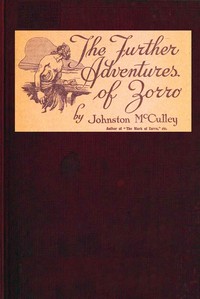
The source record for The further adventures of Zorro — Background and Themes measures this digital text at 67,606 words, 4 hr 54 min estimated reading time, and 33 detected text sections.
The text analysis averages about 12.0 words per sentence, while the detected sections provide another way to judge how the source is divided.
Project Gutenberg metadata also associates the work with “Swordsmen -- Fiction,” connecting these edition facts with the source record’s subject description.
Explore this collection
These alternatives are selected using recorded categories and estimated reading time.
About 288 minutes
Classic Adventures
66,045 recorded words. 6 minutes difference from this book's estimate.
View Gutenberg source #32465About 303 minutes
Classic Adventures
69,534 recorded words. 9 minutes difference from this book's estimate.
View Gutenberg source #25316About 284 minutes
Classic Adventures
65,148 recorded words. 10 minutes difference from this book's estimate.
View Gutenberg source #15873Search stored excerpts and compare books → Choose by your preferences →
Choices use stored catalog measurements. Estimates vary with reading speed. A shared category is a catalog label, not a claim that two books have the same argument or literary quality.
Search reads excerpt text stored with this catalog and links to its associated Gutenberg record. The connection is stored in the site database; this tool does not recheck that every excerpt is word-for-word identical to that external record. Excerpt search does not cover every chapter and does not verify historical publication dates.
Catalog snapshot checked: 2026-09-26. Coverage: 100 public books, 100 available source excerpts.
Calculated from edition completeness, EPUB availability, text structure and catalogue metadata. Not a user rating.
Total of 100 points, scaled to a 2.5-5.0 range. Editions with an empty description or a missing EPUB file are not scored.
Public-domain source text
The source text is kept in the dedicated reader, separate from this catalogue record and its commentary.
The opening chapter of The Further Adventures of Zorro immediately signals a shift in setting and tone from the earlier stories. Instead of the familiar pueblo of Reina de Los Angeles, the narrative begins at sea, with a “sinister vessel” approaching the California coast under a fog-obscured moon. The prose is deliberately atmospheric: the fog is “split as though with a sword,” and the ship’s hiss is likened to a serpent’s. The villain introduced is not a corrupt alcalde but a pirate captain named Barbados, described with grotesque physical detail—a “monstrous giant” with “pig-like” eyes and “mutilated ears.” This maritime opening establishes a new arena for Zorro’s exploits, one where the threat comes from water rats as much as land rats.
The catalog subject “Rescues — Fiction” finds its most direct expression in the pirate camp sequence. Barbados brings a captive señorita ashore, and the narrative dwells on the stronghold’s details: a “wide expanse of beach,” “stubby trees and brush,” and a “score of huts.” The pirates’ women and children jeer at the prisoner, and a jealous woman named Inez confronts Barbados. This domestic tension within the pirate community adds a layer of social realism unusual for adventure fiction. The camp is not just a backdrop but a functioning, if brutal, settlement, with “stock ran wild among the habitations.” The description of the adobe building where the señorita is held grounds the fantastical pirate raid in a recognizable California landscape.
Though Zorro himself does not appear in the provided excerpts, his presence is felt through the pirates’ fear. Barbados is “deterred” by “thoughts of the ghost of Señor Zorro,” and later tells himself that “a sea ghost cannot fight on land.” This invocation of Zorro as a spectral figure is a notable narrative choice. It suggests that the legend of the masked vigilante has grown beyond his physical actions, becoming a psychological weapon. The catalog subject “Vigilantes — Fiction” is thus reframed: Zorro’s vigilante identity now operates as a mythic force, one that the pirates dread even when he is absent. The excerpts do not confirm whether Zorro actually appears in the story, but the text strongly implies that his reputation precedes him.
McCulley’s prose in this installment adopts a nautical vocabulary that distinguishes it from earlier Zorro tales. Terms like “rakish,” “spare spread of canvas,” and “warped closer” are used with precision. The pacing of the sea chase is conveyed through repetitive action: Barbados “ran before the wind, he tacked, he beat in toward the shore, out to sea, to the north and the south and the west.” This rhythmic listing mirrors the futility of his escape attempts. The schooner’s pursuit is described in terms of gain and loss, creating a sense of relentless pressure. The catalog subject “Action and adventure fiction” is fulfilled not just through sword fights but through the technical details of sailing, which McCulley integrates into the suspense.
Readers approaching The Further Adventures of Zorro should expect a story that expands the geographical and tonal range of the series. The excerpts suggest a greater emphasis on maritime adventure and a more explicit treatment of villainy, with Barbados serving as a physically repulsive antagonist. The absence of Zorro from the opening chapters may disappoint some, but the narrative compensates by building his legend through the fears of his enemies. This installment rewards attention to setting and atmosphere, as McCulley uses the California coast to create a sense of isolation and danger.
Reading about Zorro’s ghostly menace against the pirate’s den brought back my father’s old copy of Stevenson, the one where the island felt like a single held breath. That same shiver, of a black figure waiting beyond the torchlight, came back when I later opened The Day of Resis — Themes and Context—not for the action, but for that quiet, watchful dread hiding in the margins.
Create a short personal record of your experience with this book.