About 272 minutes
The Brassbounder: A Tale of the Sea — Inside the Classic
Voyages
62,398 recorded words. 56 minutes difference from this book's estimate.
View Gutenberg source #31497
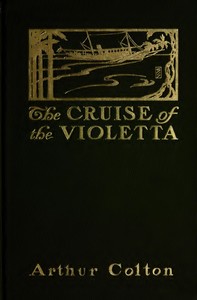
Before opening The Cruise of The Violetta — Background and Themes, the edition data offers a quick orientation: 49,517 words, 3 hr 36 min estimated reading time, and 8 detected text sections.
The text analysis averages about 13.6 words per sentence, while the detected sections provide another way to judge how the source is divided.
Project Gutenberg metadata also associates the work with “Rich people -- Fiction,” connecting these edition facts with the source record’s subject description.
Explore this collection
These alternatives are selected using recorded categories and estimated reading time.
About 272 minutes
Voyages
62,398 recorded words. 56 minutes difference from this book's estimate.
View Gutenberg source #31497About 288 minutes
Voyages
66,052 recorded words. 72 minutes difference from this book's estimate.
View Gutenberg source #57203About 381 minutes
Voyages
87,607 recorded words. 165 minutes difference from this book's estimate.
View Gutenberg source #57139Search stored excerpts and compare books → Choose by your preferences →
Choices use stored catalog measurements. Estimates vary with reading speed. A shared category is a catalog label, not a claim that two books have the same argument or literary quality.
Search reads excerpt text stored with this catalog and links to its associated Gutenberg record. The connection is stored in the site database; this tool does not recheck that every excerpt is word-for-word identical to that external record. Excerpt search does not cover every chapter and does not verify historical publication dates.
Catalog snapshot checked: 2026-09-26. Coverage: 100 public books, 100 available source excerpts.
Calculated from edition completeness, EPUB availability, text structure and catalogue metadata. Not a user rating.
Total of 100 points, scaled to a 2.5-5.0 range. Editions with an empty description or a missing EPUB file are not scored.
Public-domain source text
The source text is kept in the dedicated reader, separate from this catalogue record and its commentary.
The Cruise of the Violetta opens not at sea but in the aftermath of a fever, with the unnamed narrator convalescing in Nassau under the care of Dr. Ulswater. The doctor’s method of recovery is peculiar: he hunts cuttlefish in the harbour shoals with a three-pronged spear, calmly letting their tentacles slap around his neck while he dissects them. This early image—clinical yet absurd—sets the tone for a narrative that moves between precise observation and playful extravagance. The story is framed as a collection of manuscripts, with Dr. Ulswater’s first-person accounts embedded within the narrator’s own recollections, creating a layered structure that shifts between voices and locations.
The book’s structure is built around nested documents. The narrator introduces Dr. Ulswater, who then takes over the story through a series of manuscripts titled “First Document,” “Second Document,” and so on. These internal narratives are interrupted by the narrator’s own resumptions, as in Chapter XXIII: “I Resume the Narrative.” This technique creates a deliberate distance between events and their telling. The reader is always aware of a mediating hand—Ulswater writing, the narrator editing, and occasionally footnotes appearing. The effect is less a straightforward voyage chronicle than a puzzle of perspectives, where the reliability of any single account is subtly questioned.
Certain images recur across the excerpts, binding the disparate episodes together. The cuttlefish hunt in Nassau is echoed later when Ram Nad, the Hindu magician, performs a trick that reduces objects—and even people—to a state Susannah describes as “like custard that was all around everywhere.” The narrator’s earlier fever-induced wasting finds a comic parallel in the magician’s ability to dissolve matter. The custard metaphor is precise and odd, linking bodily fragility to magical transformation. Similarly, the act of disappearance—first of cuttlefish into Ulswater’s knife, then of dolls and Susannah into Ram Nad’s basket—becomes a structural motif, each vanishing act followed by a reappearance that defies explanation.
The narrative moves restlessly between settings, each shift marked by a change in tone. The opening in Nassau’s harbour is intimate and observational, focused on the physical details of cuttlefish and convalescence. Later scenes jump to the deck of the Violetta, where Ram Nad’s magic show turns into a chaotic dance, with Sadler chanting nonsense verse. The setting of the Island of Lua and its palace (mentioned in chapter titles) suggests a more formal, perhaps colonial, backdrop. These transitions are abrupt, often mediated by the manuscript structure: a chapter break can transport the reader from a philosophical aside to a slapstick reunion. The effect is a deliberate instability, as if the voyage itself is less a linear journey than a series of disconnected performances.
Embedded within the prose are snatches of ballad and chant. Sadler’s “tralala” refrain and the “Ballad of Georgiana and Delores” (Chapter XX) indicate that the book incorporates verse as a counterpoint to the narrative. Susannah’s dismissal of the ballad—“That’s no good now. It isn’t so.”—suggests that the poems are provisional, subject to revision by events. The verse is not decorative but functional: it provides a rhythmic release from the doctor’s analytical tone and introduces a folkloric element. The narrator’s own exclamation “Susannah, hosannah!” turns a moment of discovery into a quasi-religious chant, blending the sacred and the ridiculous. This mixing of registers—clinical, magical, lyrical—is central to the book’s peculiar texture.
Readers should attend to the gaps between the manuscripts: what is left out of Ulswater’s accounts may be as important as what is included. The narrator’s editorial presence is minimal but pointed, and the footnotes (mentioned in chapter titles) may offer clues. The book rewards attention to its structural quirks—the nested voices, the sudden shifts in scene, the recurring metaphors of dissolution and recovery. Approach it not as a conventional sea story but as a cabinet of curiosities, where each chapter opens a new drawer.
That drifting quality in The Cruise of the Violetta—the way a feverish port and a stranger’s stories blur into one long, gentle haze—reminded me of another old sea voice. There’s a quiet patience in The Brassbounder: A Tale of the Sea — Inside the Classic that lingers the same way, like salt left on skin after the tide’s gone out. I thought of it often afterward.
Use these questions to collect your thoughts before moving on.