About 468 minutes
Dick Sands, the Boy Captain — Story, Setting & Ideas
Voyages
107,463 recorded words. 0 minutes difference from this book's estimate.
View Gutenberg source #9150
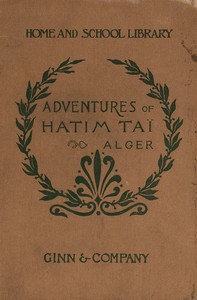
For The adventures of Hatim Taï, a romance — Themes and Context, the stored edition analysis reports 107,556 words, 7 hr 48 min estimated reading time, and 9 detected text sections.
The text analysis averages about 25.4 words per sentence, while the detected sections provide another way to judge how the source is divided.
Project Gutenberg metadata also associates the work with “Voyages and travels -- Fiction,” connecting these edition facts with the source record’s subject description.
Explore this collection
These alternatives are selected using recorded categories and estimated reading time.
About 468 minutes
Voyages
107,463 recorded words. 0 minutes difference from this book's estimate.
View Gutenberg source #9150About 489 minutes
Voyages
112,407 recorded words. 21 minutes difference from this book's estimate.
View Gutenberg source #71263About 445 minutes
Voyages
102,258 recorded words. 23 minutes difference from this book's estimate.
View Gutenberg source #48068Search stored excerpts and compare books → Choose by your preferences →
Choices use stored catalog measurements. Estimates vary with reading speed. A shared category is a catalog label, not a claim that two books have the same argument or literary quality.
Search reads excerpt text stored with this catalog and links to its associated Gutenberg record. The connection is stored in the site database; this tool does not recheck that every excerpt is word-for-word identical to that external record. Excerpt search does not cover every chapter and does not verify historical publication dates.
Catalog snapshot checked: 2026-09-26. Coverage: 100 public books, 100 available source excerpts.
Calculated from edition completeness, EPUB availability, text structure and catalogue metadata. Not a user rating.
Total of 100 points, scaled to a 2.5-5.0 range. Editions with an empty description or a missing EPUB file are not scored.
Public-domain source text
The source text is kept in the dedicated reader, separate from this catalogue record and its commentary.
This romance, originally published in Persian and translated by Duncan Forbes in the 1830s, presents Hatim Taï—a sixth-century Yemeni chieftain—as a paragon of bravery and generosity. The narrative unfolds through seven linked tales, each sending Hatim on a supernatural quest that tests his resolve and ethical compass. The editor, William Rounseville Alger, revised the translation for a broader audience in 1896, inserting explanatory phrases directly into the text to ease comprehension.
The excerpt reveals a characteristic episode: Hatim encounters a man imprisoned in a cage, blinded by a treacherous sage who applied a deceptive collyrium. The captive must repeat the maxim "Do no evil to any one; if you do, evil will befall you" until a noble youth retrieves the "flower of light" from the desert of Himyar. This blend of moral instruction, magical objects, and physical ordeal typifies the work's structure.
Hatim Taï is introduced not merely as a warrior but as an exemplar of ethical conduct. The editor's introduction describes him as an "unequalled pattern of bravery, wisdom, and generosity," and the narrative consistently places him in situations where he must choose between self-interest and altruism. In the caged-man episode, Hatim immediately pledges to help, declaring, "My friend, be of good cheer, I will instantly endeavor to effect your release." This reflexive compassion drives the plot forward, as each tale presents a new moral puzzle that Hatim must solve through action rather than contemplation.
The romance thus functions as a kind of ethical adventure: the hero's physical journeys—across deserts, into fairy realms—are inseparable from his moral development. The recurring phrase "Do no evil to any one" serves as both a warning and a thematic anchor, suggesting that the work's primary interest lies in demonstrating the consequences of human actions within a fantastical framework.
The excerpt features a collyrium that promises to reveal earthly wealth but instead blinds the user, and a "flower of light" that can restore sight. These objects are not mere plot devices; they embody a pattern where magical aids come with severe conditions or hidden drawbacks. The sage's punishment—confinement in a cage with a repetitive mantra—mirrors the structure of many tales in the collection, where characters must endure trials before receiving aid.
This pattern suggests that the romance is less about wish-fulfillment than about the discipline required to wield supernatural power. Hatim himself relies on fairies for transport, but they appear only after he has demonstrated his worth. The fairies' offer to "carry you to the spot" or "convey you to your own country" is conditional on his survival, reinforcing the idea that magical assistance is earned, not given freely.
The caged man's story is told in first person within Hatim's larger quest, a nesting technique common to Persian frame-tales. The man recounts his encounter with the sage in direct speech, creating an oral, storytelling atmosphere that invites the reader to listen rather than merely observe. Phrases like "I reflected in my own mind" and "I resolved to quit it at all hazards" give the tale an intimate, confessional quality.
This layered narration allows the romance to explore multiple perspectives on a single moral lesson. The sage's justification—"Such is the reward of treachery"—echoes through the captive's own voice, creating a chorus of cause and effect. The editor's note that the work is "not one whit inferior" to the Arabian Nights suggests that this structure was deliberately cultivated to maximize suspense and ethical resonance across the seven books.
Readers approaching this romance should attend to the interplay between its episodic structure and its moral architecture. Each tale builds on the last, but the work rewards those who notice how magical objects, oaths, and punishments recur in varied forms. The editor's revisions make the text accessible, but the original Persian cadence remains audible in the characters' formal speeches and proverbial warnings. Treat each adventure as a self-contained parable that nonetheless contributes to a unified portrait of heroic generosity.
The rain tapped against the glass while I finished the blind sage’s riddle, and I felt that same quiet wonder about distant voyages. Later, flipping through a shipping journal for no real reason, I stumbled upon Ford of H.M.S. Vigilant: A Tale of the Chusan Archipelago — Themes and Context, and it carried that same patient, untamed atmosphere—one quest simply leading into another, as if the afternoon had decided for me.
Use these questions to collect your thoughts before moving on.