About 317 minutes
The land of hidden men — Context and Discussion
Classic Adventures
72,772 recorded words. 3 minutes difference from this book's estimate.
View Gutenberg source #70536
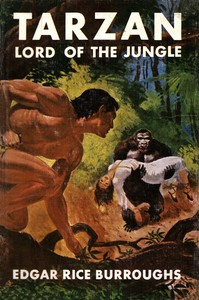
Before opening Tarzan, lord of the jungle — Context and Discussion, the edition data offers a quick orientation: 73,554 words, 5 hr 20 min estimated reading time, and 7 detected text sections.
The text analysis averages about 17.1 words per sentence, while the detected sections provide another way to judge how the source is divided.
Project Gutenberg metadata also associates the work with “Tarzan (Fictitious character) -- Fiction,” connecting these edition facts with the source record’s subject description.
Explore this collection
These alternatives are selected using recorded categories and estimated reading time.
About 317 minutes
Classic Adventures
72,772 recorded words. 3 minutes difference from this book's estimate.
View Gutenberg source #70536About 324 minutes
Classic Adventures
74,505 recorded words. 4 minutes difference from this book's estimate.
View Gutenberg source #17131About 327 minutes
Classic Adventures
75,038 recorded words. 7 minutes difference from this book's estimate.
View Gutenberg source #37215Search stored excerpts and compare books → Choose by your preferences →
Choices use stored catalog measurements. Estimates vary with reading speed. A shared category is a catalog label, not a claim that two books have the same argument or literary quality.
Search reads excerpt text stored with this catalog and links to its associated Gutenberg record. The connection is stored in the site database; this tool does not recheck that every excerpt is word-for-word identical to that external record. Excerpt search does not cover every chapter and does not verify historical publication dates.
Catalog snapshot checked: 2026-09-26. Coverage: 100 public books, 100 available source excerpts.
Calculated from edition completeness, EPUB availability, text structure and catalogue metadata. Not a user rating.
Total of 100 points, scaled to a 2.5-5.0 range. Editions with an empty description or a missing EPUB file are not scored.
Public-domain source text
The source text is kept in the dedicated reader, separate from this catalogue record and its commentary.
The novel opens not with Tarzan but with Tantor the elephant, whose ponderous bulk and century of experience set a patient, almost philosophical tone. Burroughs devotes the first chapter to the pachyderm's perspective, describing how "man alone had made war upon him" and cataloging the species that have come—black warriors, Arabs, white hunters. This choice establishes a narrative voice that frequently steps back to comment on human nature, as when the narrator declares that "hate, vengeance, envy, avarice, lust" are emotions "reserved exclusively for Nature's noblest work—the lower animals do not know them." The prose oscillates between concrete action and such editorial asides, a pattern that persists throughout the excerpts.
Burroughs's narrator frequently interrupts the action to deliver aphoristic judgments. In the opening paragraph, man is called "the most hated living organism that Nature has evolved." Later, when Ibn Jad lies to Tarzan, the narrator does not simply report the deceit but frames it through the sheik's internal calculation: "Ibn Jad was heart sick and he was thinking fast." These interjections create a dual register: the story moves forward through dialogue and physical confrontation, while the narrator supplies a running moral commentary. The effect is a voice that feels both omniscient and opinionated, guiding the reader's sympathies without relying solely on character actions.
Conversations in the excerpts are layered with subtext. When Tarzan confronts Stimbol, his questions are terse and pointed: "Where is Blake?" Stimbol's evasive replies—"You ought to know"—reveal his hostility without direct confession. Later, Ibn Jad's smooth reassurances to Tarzan—"Doubtless the poor youth thought that he spoke the truth"—are undercut by the narrator's earlier description of his fear. The dialogue thus serves a dual function: it advances the plot while exposing character through what is left unsaid. Ateja's silence is equally telling; she "did not sing nor smile" and her glances are filled with "fires of hatred." Burroughs uses spoken words and their absence to build tension and signal alliances.
The jungle is rendered through specific, physical details rather than generic exoticism. Tantor's drowsing is described with tactile and auditory precision: "his great bulk swaying to and fro," the "sultry air current" moving "sluggishly from the north." When Tarzan appears in the Arab camp, his equipment is itemized: "a spear, arrows and a knife," an "oval shield," and a "rope, hand plaited from long fibers." These details ground the fantastical elements in a tangible world. The narrative also attends to animal senses, as when Tarzan's "keen nostrils" detect threats. This sensory texture distinguishes the prose from mere plot summary, giving the reader a vivid, embodied experience of the setting.
The excerpts shift between multiple viewpoints: the omniscient narrator, Tantor's limited animal consciousness, Tarzan's focused perception, and the internal states of Arab characters like Ibn Jad and Ateja. This structural variety prevents any single perspective from dominating. For instance, the reader learns of Ibn Jad's fear and planning before Tarzan arrives, creating dramatic irony. Ateja's grief is conveyed through her actions—"she did not sing nor smile"—rather than direct statement. By alternating between external action and internal reaction, Burroughs builds a layered narrative that rewards attention to whose eyes are seeing and whose voice is speaking at any given moment.
Readers attentive to Burroughs's authorial choices will notice how the narrator's moralizing voice, the strategic use of dialogue, and the sensory richness of the jungle setting work together to create a distinctive tone. The novel does not simply chronicle adventures; it repeatedly pauses to reflect on the nature of humanity and the animal world. These observations, whether about the cruelty of man or the caution of beasts, invite the reader to consider the story as more than a straightforward adventure tale.
That rainy afternoon, I kept returning to how Burroughs lets the animals see the men—predators and prey blurring. It made the cruelty feel heavier. Later, I found myself drifting into Tarzan and the city of gold — Themes and Context, and the same quiet tension surfaced there, in the shimmer of lost cities. One book simply left me thinking of the other.
Create a short personal record of your experience with this book.