About 251 minutes
The Yellow Typhoon — A Reader’s Guide
Classic Adventures
57,687 recorded words. 1 minutes difference from this book's estimate.
View Gutenberg source #56945
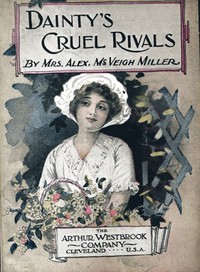
This digital edition of Dainty's Cruel Rivals; Or, The Fatal Birthday — Reading Companion is described by source-level measurements including 57,891 words, 4 hr 12 min estimated reading time, and 8 detected text sections.
The text analysis averages about 21.9 words per sentence, while the detected sections provide another way to judge how the source is divided.
Project Gutenberg metadata also associates the work with “Young women -- Fiction,” connecting these edition facts with the source record’s subject description.
Explore this collection
These alternatives are selected using recorded categories and estimated reading time.
About 251 minutes
Classic Adventures
57,687 recorded words. 1 minutes difference from this book's estimate.
View Gutenberg source #56945About 256 minutes
Classic Adventures
58,876 recorded words. 4 minutes difference from this book's estimate.
View Gutenberg source #15979About 263 minutes
Classic Adventures
60,441 recorded words. 11 minutes difference from this book's estimate.
View Gutenberg source #54916Search stored excerpts and compare books → Choose by your preferences →
Choices use stored catalog measurements. Estimates vary with reading speed. A shared category is a catalog label, not a claim that two books have the same argument or literary quality.
Search reads excerpt text stored with this catalog and links to its associated Gutenberg record. The connection is stored in the site database; this tool does not recheck that every excerpt is word-for-word identical to that external record. Excerpt search does not cover every chapter and does not verify historical publication dates.
Catalog snapshot checked: 2026-09-26. Coverage: 100 public books, 100 available source excerpts.
Calculated from edition completeness, EPUB availability, text structure and catalogue metadata. Not a user rating.
Total of 100 points, scaled to a 2.5-5.0 range. Editions with an empty description or a missing EPUB file are not scored.
Public-domain source text
The source text is kept in the dedicated reader, separate from this catalogue record and its commentary.
The opening chapter of Dainty's Cruel Rivals; Or, The Fatal Birthday introduces a love triangle laced with economic desperation. Cousins Olive Peyton and Ela Craye, schoolteachers in Richmond, Virginia, receive an invitation to Aunt Judith's country home, where the wealthy stepson Lovelace Ellsworth has just returned from Europe. Their immediate calculation—"Either you or I must capture him"—reveals a pragmatic, competitive approach to marriage. Yet both resent the inclusion of Dainty Chase, a cousin whose beauty, they admit, would "look pretty in a rag." This early contrast between Olive's cold voice and Ela's gloomy envy sets the stage for a story driven by rivalry, where romantic interest is inseparable from social and financial ambition.
The narrative relies on jealousy as a primary motivator, not merely an emotion but a force that shapes events. Olive and Ela's envy of Dainty is established in the first chapter through their dialogue: Dainty "hasn't a decent thing to wear," yet she is acknowledged as "dainty by nature." This tension between material lack and natural charm recurs throughout the excerpts. Later, the wedding scene amplifies jealousy into violence: Vernon Ashley, Ela's rejected lover, watches from a window, his face growing "dark and demoniac in its fury." The shooting of Lovelace Ellsworth is presented as the direct result of jealous passion—Ashley had earlier threatened to "stretch her dead at his feet" rather than see her marry another. The novel thus uses jealousy as a plot device that escalates from whispered schemes to public catastrophe.
The subtitle The Fatal Birthday points to a specific temporal anchor, yet the excerpts show the phrase operating as a looming threat rather than a single event. The wedding day itself becomes a "fatal" occasion: Ellsworth is shot just as he begins to speak, and the house of joy is turned "into one of gloom and sorrow." The narrative dwells on the aftermath—the victim lies in a coma, doctors unable to locate the bullet, his life hanging by a thread. This prolonged crisis suggests that the "fatal birthday" may refer not to a death but to a transformation, a day that irrevocably alters the characters' fates. The index chapters, such as "The End of the Day" and "The Darkest Hour," reinforce this sense of a single day's catastrophic ripple effects.
The prose employs heightened emotional language to delineate character and conflict. Olive speaks with "unwonted rapture in her cold voice," a phrase that immediately marks her as calculating. The villainous Ashley is described as "temporarily insane" and "as dangerous as a wild beast," while Ellsworth is simply "the victim." This stark moral coloring extends to the setting: the wedding scene shifts from festivity to horror in a single paragraph, with the pistol shot silencing both a shriek and a speech. The narrative voice does not hesitate to label emotions—"bitterest pain and jealousy," "furious raving"—creating a world where inner states are externalized and dramatic. This style, typical of late-nineteenth-century popular fiction, prioritizes clear moral stakes over psychological nuance.
Readers should attend to the way the novel balances multiple romantic threads: Dainty's apparent innocence, Olive and Ela's scheming, and Ashley's violent obsession. The excerpts leave unclear whether Ellsworth survives or which cousin he ultimately chooses. The story's tension derives less from mystery than from the certainty that jealousy will erupt again. The title's promise of "cruel rivals" is fulfilled not only in love but in the characters' readiness to destroy what they cannot possess.
I found myself thinking about Dainty’s fierce, wounded pride the other day, and how it shaped her choices. It reminded me, oddly, of another story I once read, where the daughters also carried their own quiet weights. There’s a soft ache in both, a sense of destiny pressing down. Daughters of Destiny — Story, Setting & Ideas felt like an echo of that same gentle sorrow.
Answer a few questions and save a private reflection on this device.