1

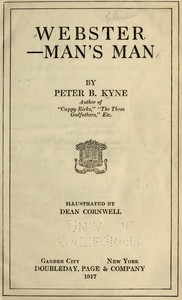
Webster—Man's Man — Themes and Context
(10 User reviews)
1881
Project Gutenberg
2016
Love stories; Adventure stories; Man-woman relationships -- Fiction; Revolutions -- Fiction; Mining engineers -- Fiction
Readers of public-domain and historical texts
Project Gutenberg digital edition
en
Edition facts
Words: 96,764
Reading time: 421 min
Text sections: 11
Source:
Project Gutenberg record #51987
An editorial note on Peter B. Kyne's 1917 novel, examining how its catalog subjects (love, adventure, revolution, mining engineering) align with the opening chapters' focus on Webster's character, voice, and interactions rather than plot-driven action.
Editorial Edition Score
4.9/5
★★★★★
★★★★★
Calculated from edition completeness, EPUB availability, text structure and catalogue metadata. Not a user rating.
Edition quality
Read the Text
ng fraternity--the signal to hoist! Only those members who had been sojourning in distant parts six months or more were privileged thus to disturb the peace and dignity of the Engineers' Club, the same privilege, by the way, carrying with it the obligation of paying for the materials shortly to be hoisted!
Having announced the return of a prodigal, our hero stepped to the door of the lounge and shouted:
“John Stuart Webster, E. M.”
The room was empty. Not a single member was present to greet the wanderer and accept of his invitation!
“Home was never like this when I was a boy,” he complained to the servant at the telephone exchange. “Times must be pretty good in the mining game in Colorado when everybody has a job that keeps him out of Denver.”
The servant rose and essayed a raid on his hat and stick, but Mr. Webster, who was impatient at thus finding himself amidst old scenes, fended him away and said “Shoo fly!” Then he crossed the empty lounge and ascended the stairs leading to the card room, at the entrance of which he paused, leaning on his stick--in unconscious imitation of a Sicilian gentleman posing for his photograph after his first payday in America--swept that room with a wistful eye and sighed because nothing had changed in three long years.
Save for the slight job of kalsomining which Father Time had done on the edges of the close-cropped Websterian moustache, the returned prodigal might have stepped out of the Club but yesterday. He would not have taken the short end of a modest bet that even a fresh log had been placed on the fire or that the domino-players over against the wall had won or lost a drink or two and then resumed playing--although perchance there _were_ a few more gray hairs in the thickly thatched head of old Neddy Jerome, sitting in his favourite seat by the window and turning the cards in his eternal game of solitaire, in blissful ignorance that John Stuart Webster stood within the portals of home and awaited the fatted calf.
“I'll hypnotize the old pelican into looking up,” Webster soliloquized, and forthwith bent a beetling gaze upon the player. For as many as five seconds he strove to demonstrate the superiority of mind over solitaire; then, despairing of success, he struck the upholstery of an adjacent chair a terrific blow with his stick--the effect of which was to cause everybody in the room to start and to conceal Mr. Webster momentarily in a cloud of dust, the while in a bellowing baritone he sang:
His father was a hard-rock miner;
He comes from my home town----
“Jack Webster! The devil's own kin!” shouted Neddy Jerome. He swept the cards into a heap and waddled across the room to meet this latest assailant of the peace and dignity of the Engineers' Club. “You old, worthless, ornery, no-good son of a lizard! I've never been so glad to see a man that didn't owe me money.” He seized Webster's hand in both of his and wrung it affectionately. “Jack,” he continued, “I've been combing the whole civilized world for you, for a month, at least. Where the devil _have_ you been?”
John Stuart Webster beamed happily upon his friend. “Well, Neddy, you old stocking-knitter,” he replied quizzically, “since that is the case, I'm not surprised at your failure to find me. You've known me long enough to have remembered to confine your search to the _uncivilized_ reaches.”
“Well, you're here, at any rate, and I'm happy. Now you'll settle down.”
“Hardly, Neddy. I'm young yet, you know--only forty. Still a real live man and not quite ready to degenerate into a card-playing, eat-drink-and-be-merry, die-of-inanition, sink-to-oblivion, and go-to-hell fireplace spirit!” And he prodded Jerome in the short ribs with a tentative thumb that caused the old man to wince. He turned to greet the halfdozen card-players who had looked up at his noisy entrance--deciding that since they were strangers to him they were mere half-baked young whelps but lately graduated from some school of mines--and permitted his friend to drag him downstairs to the deserted lounge, where Jerome paused in the middle of the room and renewed his query:
“Johnny, where have you been?”
“Lead me to a seat, O thou of little manners,” Webster retorted. “Here, boy! Remove my property and guard it well. I will stay and disport myself.” And he suffered himself to be dispossessed of his hat, gloves, and stick. “It used to be the custom here,” he resumed, addressing Jerome, “that when one of the Old Guard returned, he was obliged to ask his friends to indicate their poison----”
“Where have you been, I ask?”
“Out in Death Valley, California, trying to pry loose a fortune.”
John Stuart Webster arched his eyebrows in mock reproach. “And you can see my new suit, Neddy, my sixteen-dollar, made-to-order shoes, and my horny hoofs encased in silken hose--and ask that question? Freshly shaved and ironed and almost afraid to sit down and get wrinkles in my trousers! Smell that!” He blew a cloud of cigar smoke into Jerome's smiling face. The latter sniffed. “It smells expensive,” he replied.
“Yes, and you can bet it tastes expensive, too,” Webster answered, handing his cigar-case to his friend--who helped himself and said:
“So you've made your pile, eh, Jack?”
“Do you suppose I would have come back to Colorado without money? Haven't you lived long enough, Neddy, to realize that when a man has money he never knows where to go to spend it? It's so blamed hard to make up one's mind, with all the world to choose from, and so the only place I could think of was the old Engineers' Club in Denver. There, at least, I knew I would find one man of my acquaintance--an old granny named Neddy Jerome. Yes, Neddy, I knew I would find you playing solitaire, with your old heart beating about seven times an hour, your feet good and warm, and a touch of misery around your liver from lack of exercise.”
Jerome bit the end of his cigar and spat derisively. “How much have you made?” he demanded bluntly, “It's none of your business, but I'll tell you because I love you, Neddy. I've made one hundred thousand dollars.”
“Chicken-feed,” Jerome retorted.
Webster glanced around. “I thought at first nothing had changed in the old place,” he said, “but I see I was mistaken.”
“Why, what's wrong, Jack?”
“Why, when I was here before, they used to ask a man if he had a mouth--and now they ask him how much money he's made, where he made it, and--why, hello, Mose, you black old scoundrel, how do you do? Glad to see you. Take the order, Mose: some milk and vichy for Mr. Jerome, and a----”
“Yassuh, yassuh,” Mose interrupted, “an' a Stinger for you, suh.”
“Gone but not forgotten,” breathed Mr. Webster, and walled his eyes piously after the fashion of one about to say grace before a meal. “How sweet a thing is life with a club servant like old black Mose, who does things without an order. I feel at home--at last.”
“Johnny,” Jerome began again, “I've been combing the mineral belt of North and South America for you for a month.”
“Why this sudden belated interest in me?”
“I have a fine job for you, John----”
“King's X,” Webster interrupted, and showed both hands with the fingers crossed. “No plotting against my peace and comfort, Neddy. Haven't I told you I'm all dressed up for the first time in three years, that I have money in my pocket and more in bank? Man, I'm going to tread the primrose path for a year before I get back into the harness again.”
Jerome waved a deprecatory hand, figuratively brushing aside such feeble and inconsequential argument. “Are you foot-loose?” he demanded.
“I'm not. I'm bound in golden chains----”
“Married, eh? Great Scott, I might have guessed it. So you're on your honeymoon, eh?”
“No such luck, you vichy-drinking iconoclast. If you had ever gotten far enough from this club during the past fifteen years to get a breath of real fresh air, you'd understand why I want to enjoy civilization for a week or two before I go back to a mine superintendent's cabin on some bleak hill. No, sir-ee. Old Jeremiah Q. Work and I have had a falling out. I'm going on to New York and attend the opera, see all the good plays, mush around through the Metropolitan Museum of Art, drink tea, and learn to tango.” Webster sighed gustily. “Lord, Neddy, how I long for the fleshpots. I've slept under the desert stars so long I want electric signs for a change. Bacon and beans and sour dough are wonderful when one hasn't something better, but I crave an omelette soufflé drenched in cognac, and the cognac afire. Yes, and I want an obsequious waiter to hurry in with it and then take a dollar tip from me afterward for all the world like he was doing me a favour by accepting it. Dad burn your picture, Neddy, I want some class! I've been listening to a dago shift-boss playing the accordeon for three years--and he could only play three tunes. Now I want Sousa's band. I want to hive up in a swell hotel and leave a call for six o'clock--and then when they call me, I want to curse them, roll over, and go to sleep again. I've been bathing in tepid, dirty water in a redwood sluice-box, and now I desire a steam room and a needle shower and an osteopath. I've been bossing Greasers and Italians and was forced to learn their language to get results, and now I want to speak my mother tongue to my old friends. The last funny story I heard had whiskers on it when Rameses was playing hop-scotch in Memphis, Egypt, and by thunder I'm going to have a new deal all around.”
“Very well, Jack. Don't excite yourself. I'll give you exactly thirty days to sicken of it all--and then I shall come and claim my property.”
“Neddy, I'll not work for you.”
“Oh, yes, you will, John.”
“No, sir, I'm mad. I won't play.”
“You're it. I just tagged you.”
“I require a rest--but unfold your proposition, Neddy. I was born a poor, weak vessel consumed with a curiosity that was ever my undoing. I can only protest that this is no way to treat a friend.”
“Nonsense! My own brother wants this job, and I have refused to give it to him. Business is business--and I've saved it for you.”
Jerome leaned forward and laid his finger confidentially on Webster's knee; whereat the lighthearted wanderer carefully lifted the finger, brushed an imaginary speck of dirt from it, and set it down again. “Be serious, you ingrate,” Jerome protested. ''Listen! I've been working for two years on a consolidation up near Telluride, and I've just put it across. Jack, it's the biggest thing in the country----
Webster closed his eyes and crooned:
“I'm dying for some one to love me;
I'm tired of living alone;
I want to be somebody's darling,
To be queen upon somebody's throne.”
“Well, you'll be king on the throne of the Colorado Consolidated Mines Company, Limited. English capital, Jack. Pay 'em 6 per cent, and they'll call you blessed. There's twenty-five thousand a year in it, with a house and a good cook and an automobile and a chauffeur, and you can come to town whenever you please, provided you don't neglect the company's interests--and I know you're not that kind of an engineer.”
“Do I have to put some money into it, Neddy?”
“Not necessarily, although I should advise it. I can let you in on the ground floor for that hundred thousand of yours, guarantee you a handsome profit and in all probability a big clean-up.”
“I feel myself slipping, Neddy. Nevertheless, the tail goes with the hide. I'm not in the habit of asking my friends to guarantee my investments, and if you say it's all right, I'll spread what I have left of the hundred thousand when I report for duty. What's the news around this mortuary, anyhow? Who's dead and who's alive?”
“It's been a tremendous job getting this consolidation over, Jack. When----”
“In pity's name! Spare me. I've heard all I want to hear about your confounded consolidation. News! News! Give me news! I had to beg for a drink----”
“I might remind you that your manners have not improved with age, Jack Webster. You haven't thanked me for that job.”
“No--nor shall I. Mose, you black sinner, how dare you appear before me again without that stinger?”
Mose, the aged coloured porter of the Engineers' Club, flashed a row of ivories and respectfully re-turned the democratic greeting.
“Letter for you, suh. The secretary told me to give it to you, Mistah Webster.”
“Thank you, Mose. Speak up, Neddy, and tell me something. Ever hear anything of Billy Geary?” He was tearing the edge of the envelope the while he gazed at Jerome, who was rubbing his fat hands together after the fashion of elderly men who are well pleased with themselves.
“You have a chance to become one of the greatest and richest mining engineers in the world, Jack,” he answered, “now that you've cut loose from that young crook Geary. I don't know what's become of him, and neither does anybody else. For that matter, nobody cares.”
“I do--and you can take the brief end of that bet for your last white chip. Don't let me hear you or anybody else say anything against Billy Geary. That boy goes for my money, every turn in the box. Don't make any mistakes about that, old-timer.”
Webster's face suddenly was serious; the bantering intonation in his voice was gone, and a new, slightly strident note had crept into it. But Jerome, engrossed in his own affairs, failed to observe the menace in that swift transition of mood in his companion. He waved his hand soothingly.
“All right, old Johnny Pepper-box, have it your own way. Nevertheless, I'm a little mystified. The last I knew of you two, you had testified against him in the high-grader trials at Cripple Creek, and he had pulled out under a cloud, even after his acquittal.”
“Give a dog a bad name, and it will stick to him,” Webster retorted. “Of course I testified against him. As engineer for the Mine Owners' Association, I had to. The high-grade ore was found in his assay office, and the circumstantial evidence was complete, and I admit Billy was acquitted merely because I and others could not swear positively that the ore came from any certain mine. It was the same old story, Neddy. It's become history in all mining camps. You can be morally certain that high-grade ore has been stolen from your mine, but unless you catch the ore thief in the act, how can you prove it? High-grade ore is blind goods and is not confined to any certain man-owned spot on this wicked earth--so there you are! I suppose you read the newspaper reports and believed them, just as everybody else does.”
“Well, forget it, Jack. It's all over long ago, and forgotten.”
“It wasn't all over so long ago as you seem to think. I suppose you knew the Holman gang was afterward sent to the penitentiary for those same high-grade operations?”
“But I'll bet my new plug hat you never knew I was the _Hawkshaw_ that sent them there! You bet I was! Billy Geary's acquittal didn't end my interest in the case--not by a jugful! I fought the case against the friends of the Holman crew _among the mine owners themselves_; and it cost me my good job, my prestige as a mining engineer, and thirty thousand dollars of money that I'd slaved to get together. They squeezed me, Neddy--squeezed me hard like a lemon, and threw me away, but I got them! I should tell a man! Of course you never knew this, Neddy, and for that matter, neither does Geary. I wish he did. We were good friends once. I certainly was mighty fond of that boy.”
He drew the letter from the envelope and slowly opened it, his mind not upon the letter, but upon Billy Geary.
“And you never heard what became of Geary?”
“Not a word. I was too busy wondering what was to become of me. I couldn't get a job anywhere in Colorado, and I moved to Nevada. Made a million in Goldfield, dropped it in the panic of 1907, and had to start again----”
“What have you been doing lately?”
“Borax. Staked a group of claims down in Death Valley. Bully ground, Neddy, and I was busted when I located them. Had to borrow money to pay the filing fees and incorporation, and did my own assessment work. Look!” Webster held up his hands, still somewhat grimy and calloused.
“How did you get by with your bluff?”
“In the only way anybody ever got by on no pair. I was a brave dog and went around with an erect tail, talking in millions and buying my tobacco on jawbone. The Borax Trust knew I was busted, but they never could quite get over the fear that I'd dig up some blacking and give them a run--so they bought me out. Two weeks ago I got a belated telegram, telling me there was a hundred thousand dollars in escrow against deeds and certificate of title in a Salt Lake City bank--so here I am.”
“Somebody told me Geary had gone to Rhodesia,” Jerome continued musingly, “or maybe it was Capetown. I know he was seen somewhere in South Africa.”
“He left the Creek immediately after the conclusion of his trial. Poor boy! That dirty business destroyed the lad and made a tramp of him, I guess. I tell you, Neddy, no two men ever lived who came nearer to loving each other than Billy Geary and his old Jack-pardner. We bucked the marts of men and went to sleep together hungry many a time during our five-year partnership. Why, Bill was like my own boy! Do you know, Neddy, now that I've rounded the forty-pole, I get thinking sometimes, and wish I could have married when I was about twenty years old; I might have had a son to knock around with now, while I'm still in the shank of my own youth. And if I had been blessed with a son, I would have wanted him to be just like Billy. You know, Bill tied onto me when he was about eighteen. He's rising twenty-six now. He came to me at the Bonnie Claire mine fresh from high school, and I staked him to a drill; but he didn't stick there long. I saw he was too good a boy to be a mucker all his days.”
Webster smiled reminiscently and went on: “I'll never forget the day Billy challenged a big Cornish shift-boss that called him out of his name. The Cousin Jack could fight, too, but Billy walked around him like a cooper around a barrel, and when he finished, I fired the Cousin Jack and gave Billy his job!”
He chuckled softly at the remembrance. “Too bad!” he continued. “That boy had brains and grit and honour, and he shouldn't have held that trial against me. But Billy was young, I suppose, and he just couldn't understand my position. It takes the hard old years to impart common sense to a man, and I suppose Billy couldn't understand why I had to be true to my salt. He should have known I hadn't a leg to stand on when I took the stand for the prosecution--not a scintilla of evidence to present, except that the high-grade had been found in his assay office. Jerome, I curse the day I took that boy out from underground and put him in the Bonnie Claire assay office to learn the business. How could I know that the Holman gang had cached the stuff in his shack?”
“Well, it's too bad,” Jerome answered dully. He was quite willing that the subject of conversation should be changed. “I'm glad to get the right dope on the boy, anyhow. We might be able to hand him a good job to make up for the injustice. Have another drink?”
“Not until I read this letter. Now, who the dickens knew I was headed for Denver and the Engineers' Club? I didn't tell a soul, and I only arrived this morning.”
He turned to the last page to ascertain the identity of his correspondent, and his facial expression ran the gamut from surprise to a joy that was good to see.
Peter B. Kyne's Webster—Man's Man opens not with a revolution or a love interest but with John Stuart Webster, a mining engineer, flagging down a train in Death Valley. His first thoughts are of ham and eggs, cigars, and a new suit—a mundane list that immediately establishes a voice both wry and concrete. The catalog subjects list 'Revolutions' and 'Man-woman relationships,' yet the excerpts show Webster more concerned with a drunkard's self-respect than with romance or political upheaval. This note traces how the novel's early chapters foreground character and moral authority over the adventure promised by its metadata.
The Opening: Ham, Eggs, and a Moral Compass
The first chapter devotes several paragraphs to Webster's plan for a 'debauch' of ham and eggs, cigars, and a ready-to-wear suit. This inventory is not mere scene-setting; it reveals a man who values order and reward. Kyne writes that Webster 'had definitely resolved to do certain things,' and the list that follows is precise: twenty dollars' worth of ham and eggs, nicotine from tobacco 'with nicotine in it,' and a suit he will later donate to a prospector. The voice is knowing, almost conspiratorial, as when the narrator notes that 'the August temperature in Death Valley is no respecter of moisture in any man or his tobacco.' This opening establishes a protagonist who plans his pleasures as carefully as his work, and who measures civilization by its small comforts.
Character Through Gesture: The Eye and the Hand
Webster's authority is conveyed not through declarations but through physical detail. When he encounters Don Juan Cafetéro, a drunkard, Webster puts 'a big forefinger under your chin and bade you hold up your head.' The gesture is repeated in Dolores's memory, and it defines Webster more than any speech. Later, Cafetéro returns a five-dollar piece, sober but shaking, and Webster responds with a measured prescription: 'a large jolt of aguardiente' to steady his nerves, then three more drinks spaced through the day. The catalog subject 'Man-woman relationships' appears in Dolores's observation of Webster—'A doer of deeds are you'—but the excerpt focuses on her watching him handle a broken man. The romance is deferred; the moral test is immediate.
Voice and the Vernacular of Authority
Kyne's narrator adopts a colloquial, knowing tone that matches Webster's own. Phrases like 'kicker-up-of-dust on distant trails' and 'the pinnacle of epicurean delight' mix slang with mock-formality. The dialogue is marked by dialect: Cafetéro speaks in a stage-Irish brogue ('Shure, Misther Geary do be the fine lad'), while Dolores quotes Kipling. Webster himself speaks plainly, giving orders without explanation. This voice—confident, slightly sardonic, grounded in physical detail—carries the early chapters. The catalog subject 'Adventure stories' suggests action, but the excerpts offer a different kind of adventure: the management of a man's own appetites and another man's weakness. The revolution and love story remain offstage, hinted at only by Dolores's whispered line and the mention of a missing Mr. Geary.
The excerpts from Webster—Man's Man suggest a novel more interested in character and moral economy than in the revolutions or romances its catalog subjects promise. Readers expecting swift action may find instead a deliberate, almost procedural attention to how a man earns trust and gives orders. The opening chapters reward patience with a voice that is both specific and dryly humorous. Those who enjoy Kyne's later work—Cappy Ricks or The Three Godfathers—will recognize his method: a hero defined by small, telling choices rather than grand gestures.
William Flores
2 weeks agoScarlett Wilson
2 weeks agoOliver Garcia
1 week agoAria Harris
3 weeks agoThere are no comments for this eBook.
Reader reflection
Record your reading impressions
A brief reflection can help important ideas stay with you longer.
Your progress
0
/
10
2
Did this book hold your interest?
3
How likely are you to recommend this book?
4
How easy was the book to follow?
5
Did this book create an emotional response?
6
Would you start a conversation about this book?
7
How well did it match your expectations?
8
How distinctive were its ideas or approach?
9
Which lesson or insight stayed with you?
10








Gabriel Nguyen
2 weeks ago