1

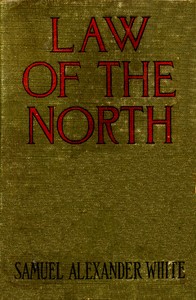
Law of the North (Originally published as Empery) A Story of Love and Battle in Rupert's Land — Key Ideas to Explore
(11 User reviews)
1340
Project Gutenberg
2013
Canada -- Fiction; Adventure stories
Readers of public-domain and historical texts
Project Gutenberg digital edition
en
Edition facts
Words: 54,518
Reading time: 238 min
Text sections: 6
Source:
Project Gutenberg record #41962
An editorial note examining the narrative voice and pacing in Samuel Alexander White's frontier adventure, focusing on the opening portage scene, the tracking of Gaspard Follet, and the use of French song to vary rhythm.
Editorial Edition Score
4.7/5
★★★★★
★★★★★
Calculated from edition completeness, EPUB availability, text structure and catalogue metadata. Not a user rating.
Edition quality
Read the Text
not know where the girl was. All he knew was that she harkened to the wooing of Black Ferguson, our enemy. She made trysts with him in spite of our vigilance, and finally escaped to his forts and married him. Married him and bore a son to him in the face of Macleod's black wrath! You know the Stern Father, Running Wolf. You know how such a thing would gripe. How he would writhe under the scorn of his foe and under the northland's mocking laughter! You know?"
"_Ae_," answered Running Wolf. "I know."
"Then you understand. 'Go out,' he said to me. 'I will not brook it. Go out. I have never been bent by man or devil. Go out! Raze forts! Burn! Kill! But bring back her and her boy.' And that I will do, Running Wolf. I obey his orders. The White Squaw, as you call her, returns with me."
A shade of anger crossed the Cree's copper-colored face. He drew back a step, his shoulders raised in haughty pride.
"Thus at a late day, Strong Father," he said, "you have turned enemy to me and to my people!"
"Not so," Dunvegan contradicted. "I am still your friend, as you have had cause to know. But I have my orders. I must do the Stern Father's bidding. Running Wolf, you say to your young men: 'Go forth and do such a thing.' It is done as you command. You have power and wisdom to rule, and the braves, recognizing your authority and holding the tribe's interests at heart, will do your mission if they die in the doing. Is it not so with your people, my friend?"
"_Ae_," replied the chief with warmth. "It is so, for I have many trusted ones."
"Then"--Dunvegan was quick to follow up his advantage--"it is even so with me. I do my duty to my Company and to my Factor, whom you rightly call the Stern Father. Do you understand, Running Wolf?"
"I understand," responded the Cree. "I see that you come in no bitterness, and the White Squaw shall go as you say."
Flora Macleod was quick to voice her disapproval of his words.
"Have you no spirit?" she cried wrathfully. "Do you give in when there is a tribe at your back? Running Wolf, you haven't the courage of a rabbit. Your son were fitter to rule these wigwams than such an old fool of a father! A pretty mind to guide a people!"
"I give in to save my children trouble and strife," returned Running Wolf gravely. "I know Strong Father well. He would fight for as little as a blanket stolen from his Company, although his heart is friendly. You shall go, White Squaw, but I go also. I go to take counsel with the Stern Father, to ask that you abide in my lodge."
The tone of his last statement told Dunvegan that on this point he was adamant. Flora Macleod flounced back to her child, the wrath of her soul choking at her lips.
"Make ready," urged the chief trader. "We start at once."
He waited by the chief's tepee while the two set about what slight preparations were needed for departure and watched the clean-limbed bucks idling down to the Katchewan's bank. Three Feathers, brooding in his spiteful anger, loitered with them, on edge to create a disturbance. Dunvegan saw that the Indians were massing at the landing-point, and he shouted a command to his men to keep them away.
Pete Connear, an American and an ex-sailor who had drifted north by the Red River route and entered the Company's service, did as directed, but the braves gave ground sullenly. Three Feathers himself became vociferous.
"Dogs and sons of dogs," he anathematized them, "you have hearts of water to steal about, capturing women."
"Shut up," advised Connear dryly.
"Salt Rat," Three Feathers sent back, stamping in impotent rage, "there is no place for you here in the forest. Get away to your Big Waters."
He emphasized his language with a swift-thrown palmful of slimy sand, which struck the ex-sailor squarely in the eyes. Connear roared like a bull and leaped ashore from his birch-bark craft.
"You bloomin' copper-hide," he bellowed in blind wrath, "I'll man-handle you for that."
Three Feathers was swift, but in anger Pete Connear was swifter. Almost before the young chief realized it the sailor was upon him. The Cree's wrists were pinned behind his back in the grip of Pete's left hand; he was whirled over the sailor's knee and given as sound a spanking as ever a recalcitrant child received.
Connear's palm was hard with years of searing brine; and Three Feathers was blessed with no stoicism. He howled pitifully, while the Hudson's Bay men shouted in uproarious mirth.
But the young bucks of the crowd failed to see the humor of the situation. They gathered together with much muttering and gesturing. Dunvegan, shaking with laughter at the plight of Three Feathers, caught the signs of impending trouble and came running forward as Connear completed his enemy's chastisement.
"There!" exclaimed the bespattered Pete. "I've slippered your hide, and now I'll roll you in the scuppers just for sailor's luck!" He shot Three Feathers from his knee and sent him rolling down the bank into the river, from which the young man pulled himself out as bedraggled as a fur-soaked beaver.
The Cree bucks charged on the instant at the lone sailorman, but Dunvegan's arm waved as he ran, and like magic his men were out of their canoes and lined up on the river margin with guns at full cock. Connear danced a sailor's hornpipe in the center and hooted in delightful anticipation of a fight.
The crisis seemed inevitable. A trade-gun barked in the rear. The braves, with murder in their untamed hearts, shook out their weapons ready to throw their weight against Dunvegan's line, but a deep-throated Cree voice held them on the verge of their madness.
"Stop!" called the vibrant voice of Running Wolf, "or I blast you with the evil spirit."
As one man the crowd turned and looked at the speaker.
The old chief stood behind them with Flora and her child. He was arrayed in the robes of a medicine-maker, for Running Wolf was a man of magic as well as a leader among his people. He carried the full equipment of a head medicine-man of his tribe.
The effect of his appearance on the malcontents was instantaneous. Arms which had raised weapons dropped to the owner's sides. A great awe grew in the eyes of the braves. Running Wolf raised his medicine-wand, sweeping it in a half circle.
"Go back to your lodges!" he ordered.
The Crees obeyed. There arose no murmur, no protest.
Dunvegan knew Running Wolf could not have done this thing by his powers of chieftainship. He marveled how in their wild bosoms the fear of the unknown overshadowed their defiance of the power of personality. Assuredly it was strong medicine.
The chief took the indicated place in Dunvegan's canoe with Flora and her boy. These sat amidships. Wahbiscaw was in his place as bowsman. Bruce himself occupied the stern. At a sign from him the whole brigade floated off, the prows pointing up the swift-flowing Katchawan. Thus for an hour the paddles dipped in rhythm. They threaded the river's island channels and won through its rushing chutes. Where the rapids proved too swift for paddles they poled the craft up with long spruce poles. Few words were spoken. It was the custom to travel in silence. One reason for this was that Nor'west traders might be lurking anywhere. Another was that game might be encountered around any of the many river bends.
But the brigade left the Katchawan without a sight of game and entered the mouth of Lake Lemeau. Maskwa, the Ojibway fort runner, stood erect, sentinel-like, in the canoe behind Dunvegan, his keen eyes searching the lake waters for sign of friend or foe. Quite suddenly he sat down.
"Canoe, Strong Father," he grunted gutturally.
"Where?" the chief trader asked.
Quietly Dunvegan shifted his bow till the canoe bore a course which would bring them directly in the path of the strange craft. He had no idea whose it might be. It might belong to some trapper or to some Indian of their own Company. It might belong to the Nor'westers. It might carry free traders. Whatever it was, it was his duty to find out.
Warm yellow the bark shone as the distance lessened. Sapphire glints flashed out as the paddles flickered after each plunge. Soon the men of the brigade could see that the craft contained four figures, but it was Maskwa's long-range vision which discerned their nationalities.
"Ojibways, two; white men, two," he announced. "Good paddlers."
And so it proved when they drew near. Dunvegan saw, seated behind the native bowsman, a keen-visaged, lean, athletic man of forty. He had a smooth face, sandy hair, eyes of a cold, hard blue, a beak nose, and great, sinewed arms. About him was the stamp of the frontier. Instinctively at first glimpse the chief trader catalogued him as one who had seen much frontier fighting, who had handled guns and bad men running amuck with guns.
Fit mate for him looked the one sitting toward the stern. He was abnormally broad of shoulder, stocky, powerful, black-bearded, black-eyed. The sun had smoked him till he was as swarthy as the Ojibway steersman. Of the two white men he looked the more dangerous, for there was no humor in his steady eyes. His companion's gaze, cold and hard as it was, held something of a quizzical gleam. Perhaps it was the hollows under those eyes that gave him that appearance.
As Dunvegan's craft met the other almost bow to bow and slipped ahead, the gunwales grated gently. Bruce closed a hand on the gunwales of the other and the two canoes drifted as one.
The sandy-haired man's semi-humorous eyes flashed a quick look aboard, and then he smiled. "You sure couldn't do that, stranger, if my pardner and me hadn't decided to speak to you," he observed.
"Couldn't I?" challenged Dunvegan. He scrutinized men and outfit. "Free traders, I suppose?"
"You got another guess coming yet."
"Oh, quit it, Granger," the black-bearded man broke in, stirring impatiently among the dunnage bags. "You're wasting time. Show him the star."
The sandy-haired one twisted his suspender band. Dunvegan saw the badge of a United States Marshal.
"It's genuine, stranger. And we're sure not here for our health. Are we, Garfield?"
"No," growled the black-bearded marshal. "A show-down's the thing that we're after."
"You fooled me," laughed Dunvegan. "But you had better exhibit your papers. My Factor is death on free traders; and I have to report to him, you know."
"Who's your Factor?" the smooth-faced marshal asked as he dived into the pocket of his buckskin coat that was stuffed under the forward thwart.
"Macleod, of Oxford House."
"Macleod, eh? Macleod!" rumbled Granger while he searched. "Don't know him. But we sure will when we get to his post. We've been up around the Bay forts. When we've done Norway House and the posts out that way we'll be across to Oxford. See you again, then. Hello, here's the papers!"
He handed Dunvegan two frayed documents. As he scanned them the chief trader saw they were genuine enough. The first was an order of the chief district factor of the Hudson's Bay Company declaring all forts open to the bearers. The second was a similar mandate of the Northwest Fur Company for use in their posts and issued from the headquarters in Montreal.
"These are through passes," smiled Dunvegan, handing them back. "I know the chief district factor's signature. And it seems you are equipped for a hunt in Nor'west country as well. Is there anything I can do for you?"
"You've done all you can do--let us see you and your men," grinned Granger. "That's all we wanted. Eh, Garfield?"
"That's all," Garfield agreed, condescending to laugh so that his gleaming white teeth split his black beard. "Hit her up there, you bucks," he commanded the Ojibways.
The Indians seized their paddles. Dunvegan let go the gunwales. "Good luck," he nodded.
"Hold on," yelled Granger suddenly. "Maybe I ought to say more. A hint from you would sure save us some miles. Here, look at this!"
He dived again into the buckskin coat and handed a photograph across the water gap.
"Do you know him?" he demanded, keenly reading the chief trader's face. "Mind, I don't say he's what we're after. I don't say he's done anything. Do you know him? He's in the service of one of these fur companies."
The picture Dunvegan looked at was that of a bare-faced man in robust health, a strong man who was in the super-strength of his prime. The eyes were vivid, clear as crystal, sharp as steel. The chief trader felt that the glance of the living original would cut like a knife. These eyes puzzled him with a sense of vague familiarity, but the face he scanned was the face of no one in his memory-gallery.
He shook his head, and oddly enough he felt a reluctance, a disappointment in denial. "I don't know him," he decided, and handed the photograph back.
Like a hawk Granger had watched his face. He read truth in it. "Oh, well!" he exclaimed whimsically. "The way of the transgressor and the marshal is sure hard." Once more his quizzical expression flashed forth as he twirled his paddle aloft in good-by.
"Shake, stranger," he threw back in final farewell, while the long craft leaped under the Ojibways' strokes. "Shake! Till I see you at Oxford House!"
Flora Macleod watched the solitary canoe drop away out of sight. Then, when it was gone, she leaned forward to the chief trader's shoulder.
"Was that last answer of yours lie or loyalty?" she asked with strange timidity.
Dunvegan turned a surprised face. "It was ignorance," he amended. He saw Flora's cheeks pale, her eyes full of a haunting fear.
"What's wrong?" he demanded in astonishment.
"That picture--I--I saw it, too."
"It was my father's!"
Dawn set a wall of flame on Oxford Lake. Out of this solar furnace drifted a fleet of canoes black as charred logs against the cardinal blaze. Clement Nemaire, sentinel at the stockade gates of Oxford House, caught sight of the craft in the immense distance advancing with a motion which, though scarcely discernible, nevertheless brought them gradually into large perspective. His black eyes, keen as lenses, steadily watched the approaching flotilla while it breasted Caribou Point and crossed the outer rim of the Bay. When the fleet drew opposite Mooswa Hill, the mighty rampart upon whose crest a brushwood beacon stood always piled ready for firing by the Hudson's Bay fort runners as a warning message of impending Nor'west attacks, Clement made out the sharp, black line of a flagstaff in the bow of the foremost canoe. From the staff's tip a long standard bellied like a sail in the cross wind, its vivid hue blending with the fiery background, and Nemaire knew the familiar blood-red banner of his Company.
"De brigade!" he shouted for all the post to hear. "_Holá!_ De beeg brigade!"
Every soul of Oxford House sprang forth at his cry. In a heterogeneous crowd the people spread to the landing at the lake-shore. White traders, fair-skinned women, full-blooded Indians, halfbreeds, squaws, papooses, huskies,[1] all mingled in polyglot confusion. Curs barked; children squealed; native tongues chattered in many languages. Eager expectancy, intense interest, was the sensation of each human being or animal that waited on the beach. Their wild hearts, keyed to a love of the vast places, to a worship of all the attributes of wilderness life, could never welcome a brigade unmoved. That distinct institution of the Hudson's Bay Company was a thing which they idolized and revered. The crowd in a fever of joyous excitement pressed to the very water's edge and shifted the length of the landing. Each minute of waiting they filled with clamor and gesticulation, the hum of voices growing to a roar as Dunvegan's brigade approached within hailing distance.
[Footnote 1: Eskimo sledge dogs.]
But behind them a heavy step sounded on the veranda of the Factor's house, and looking, they saw the square-set bulk of Malcolm Macleod. A hush blanketed the confusion. Not a foot or tongue stirred by the lake-edge. So deep was the stillness that the slight wash of the plunging canoes could be heard distinctly. The Factor did not speak, but his bushy eyebrows lowered and the piercing gaze of his steely, black eyes was concentrated on the scene. His iron hands, symbols of the man, gripped the railing tightly. Like the crowd, he waited; but while their impelling motive was curiosity, Macleod's was judgment.
The fleet of canoes lined for the landing, the figures of the occupants growing clear. The throng could now see that the chief trader and Wahbiscaw, his bowsman, had two passengers in the foremost craft. When they became recognizable as Flora Macleod and Running Wolf, whispers of wonder and speculation began to circulate. Discussion ran like the murmur of low waters from Father Brochet, the black-cassocked, unobtrusive priest on the outer rim of the gathering, to rude Gaspard Follet, the owl-faced, dwarf-shaped, half-witted fool who sat on the end of the landing with bare feet in the water, that he might be closest to the incomers.
Conversing in a little group beside Father Brochet stood Desirée Lazard, the fairest of Oxford House; Pierre, her uncle, and Basil Dreaulond. As the brigade touched the bank, the rushing people blotted it out. The paddlers leaped ashore, stretched cramped limbs, and were swallowed up in the throng. Presently the mighty figure of Bruce Dunvegan emerged, leading Running Wolf and Flora Macleod from the landing toward the Factor's house.
Contrary to his usual custom, Malcolm Macleod did not turn into his council room to receive the report and do his questioning. The fact that the runaway daughter appeared before him accounted for his coming down a few steps to await the trio.
"You've succeeded," he growled unceremoniously, bending his angry glance, not upon the chief trader, but upon Flora, who returned a stare of equal intensity.
"Not altogether," complained Dunvegan. "Things are not as clear as I could wish. I found the girl in Running Wolf's lodge. I understand Black Ferguson deserted her near the Cree camp."
Macleod's habitually active brain seemed slow in comprehending the statement. The tight lines of his mouth relaxed, and his jaws jarred apart in an attitude of sheer amazement.
"Stern Father," Running Wolf hastened to add, "it is my wish and the White Squaw's wish that she remain in my lodge. As for the sun and the stars and the south wind is my worship for her. I have come for your consent." He bowed in his brief oratorical delivery and smoothed his medicine-maker's dress.
"Consent!--Squaw!" boomed Macleod, blank astonishment giving way under the swift rush of his tremendous rage. "You d--d Cree demigod--that's my consent!" And his strong hands hurled Running Wolf headlong from the veranda steps almost to the rim of the gaping crowd.
The old warrior picked himself up in a frenzy of spirit and, forgetting all traditions and restraints, rushed insanely at the Factor. But Dunvegan blocked his path and grasped the uplifted hand.
"Don't do that, Running Wolf," he warned. "You can only work your own ruin. A blow would mean your death!"
Chest heaving, eyes blazing, the Cree chieftain strained a moment after his insulter. Dunvegan's strength forced him back and instilled some substance of sanity. When he found his voice, his speech trembled with hate.
"You are Stern Father now," he hissed in Cree, "but I can change it to Soft Father----"
Macleod took a step forward as if on sudden impulse to crush once for all a defiance flung in his teeth, but he caught the look of entreaty for lenience in the chief trader's eyes. He halted. Yet Running Wolf was not to be appeased. He glared vindictively into the very face of the lord of Oxford House.
"Soft Father you shall be," he declared. "I go to the French Hearts. We will meet again before many moons. Then my hands shall hurl. My words shall curse. You shall be as the broken pot of clay, as the water of melting ice, as the pool of blood where the big moose falls."
The chief's momentarily-lost stoicism was regained. His dignity, which the red man seldom loses, had returned.
Dunvegan, his hands still upon the Cree's arms, felt the change in him, felt him straighten with pride. He released his grip.
The opening of Law of the North (originally Empery) establishes a distinctive narrative voice that blends precise physical description with an undercurrent of tension. The courier Basil Dreaulond, hearing men on the Nisgowan portage, reacts with a trained, almost mechanical alertness: he hides his canoe, pack, and himself, then makes ready his weapons. The prose is economical, favoring concrete actions over internal commentary, and the setting—boulder-strewn woodland, tamarack thicket, blazed passage—is rendered with a surveyor's eye for detail. This opening suggests a world where survival depends on acute sensory awareness and swift, silent decisions.
The Rhythm of the Portage
The first chapter's pacing is deliberate, matching the physical effort of the portage. White uses short, declarative sentences to convey Dreaulond's movements: "He stopped automatically and trained his hearing in mechanical analysis of the sound." The narrative then slows to describe the hiding of the canoe and the creation of a peep-hole among "pungent boughs." This alternation between action and observation creates a rhythm that mirrors the courier's cautious advance. The arrival of the Nor'westers is deferred, building anticipation through the detailed scrutiny of the path—"flinty rock fragments, spear-like stumps, and a chaotic jumble of logs." The voice remains detached, reporting sensory data rather than emotion, which heightens the sense of professional competence under threat.
Tracking and the Voice of the Ojibway Runner
Later in the text, the narrative voice shifts when Maskwa, the Ojibway fort runner, takes the lead. His speech is terse and observant: "I made the shoes," he says of snowshoe tracks, identifying them by the curve of the knots. The dialogue between Maskwa and Chief Trader Dunvegan is clipped, with Maskwa's responses carrying an ironic edge—"The Little Fool is glad to meet with the Company's servants," he remarks after capturing Gaspard Follet. This section demonstrates how White varies pace through dialogue: the tracking scene is methodical, with pauses for examination of the snow pattern, while the capture is abrupt, with Maskwa dragging Follet from the bushes. The narrative voice here is lean, letting the characters' actions and sparse words carry the tension.
Song as a Change of Pace
A notable shift in rhythm occurs when Baptiste Verenne sings a French folk song during the march: "Te souvient-il de cette amie, Douce compagne de ma vie?" The lines, quoted in full, introduce a lyrical pause into the otherwise grim journey through Nor'west country. The song contrasts with the sailor's gruff "Bucko! Bucko!" and Terence's frown, creating a moment of cultural texture and emotional respite. White uses this interlude to vary the narrative tempo—after the song, the prose returns to "desolate grayness" and the strict lookout. This technique suggests that the author is deliberately controlling pace not only through action and dialogue but also through embedded verse, which momentarily lifts the story out of its immediate peril and into a broader, more reflective register.
Readers attentive to narrative craft will notice how White orchestrates tension through sentence length, dialogue density, and the strategic placement of song. The story rewards those who watch for shifts in rhythm—from the staccato of a portage to the measured tracking of snowshoe prints to the unexpected lyricism of a voyageur's refrain. These variations give the prose a texture that complements the rugged setting.
Michael Sanchez
6 days agoDylan Martin
2 weeks agoCharlotte Clark
3 weeks agoOwen Adams
3 weeks ago-

Cynthia Martinez - 1 month ago
{'review_type': 'negative', 'content': 'Law Of The North suffers from excessive exposition and melodramatic dialogue. The characters are flat archetypes, and the romance feels contrived. The pacing is painfully slow, with long stretches of description that add little to the story. Despite its potential, the execution is bland and fails to capture the epic scope it aims for.'} -
Gloria Thomas - 3 weeks ago
{'review_type': 'positive', 'content': "Law Of The North is an epic historical romance set against the rugged backdrop of Rupert's Land. The author excels at weaving together themes of love, loyalty, and survival in a harsh wilderness. The characters are compelling, and the pacing is perfect, balancing action with introspective moments. A powerful and immersive read."} -
Andrew Gonzalez - 3 days ago
{'review_type': 'neutral', 'content': "Law Of The North has a strong sense of place and a gripping love story at its heart. However, the historical detail sometimes overwhelms the narrative, and certain plot threads are left unresolved. It's an ambitious work that succeeds in many ways, but readers may find it uneven and occasionally slow."}
Reader reflection
What was your reading experience?
Capture what you thought, learned, and would like to remember.
Your progress
0
/
10
2
How much did you enjoy the reading experience?
3
Is this a title you would suggest to others?
4
How much effort did this book require?
5
How distinctive were its ideas or approach?
6
How clear did the writing feel?
7
Would you read this book again?
8
What did you appreciate most?
9
What did this book teach you most?
10








Harper Anderson
4 weeks ago