
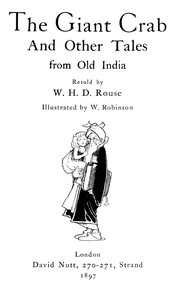
The Giant Crab, and Other Tales from Old India by W. H. D. Rouse
Let's clear something up first: this isn't a novel. The Giant Crab is a collection of traditional folktales from the Jataka tales and the Panchatantra, which are ancient Indian story traditions. W.H.D. Rouse, a classicist and folklorist, translated and adapted them for English readers in the early 1900s. Think of it as a sampler platter of wisdom literature, where animals talk, kings get schooled, and every story has a point—but rarely the one you first expect.
The Story
There's no single plot. Instead, you jump from one self-contained tale to the next. You'll meet the titular Giant Crab, a formidable guardian of a pond. You'll follow the famous feud between the cunning Monkey and the persistent Crocodile. A brave quail discovers the power of collective action. A foolish man tries to milk a bull. Each story is short, often just a few pages, and almost always ends with a clear moral. But these aren't just simple lessons for kids; they're often about political savvy, the pitfalls of greed, and the surprising strength of the seemingly weak.
Why You Should Read It
I was hooked by the sheer personality in these tales. The writing is clean and direct—Rouse wanted the stories to speak for themselves. What I love is how they bypass modern complexity and hit on universal truths. The monkey isn't just clever; he uses logic and trickery to survive. The lessons feel earned, not preachy. Reading them, you get a direct line to the humor and practical wisdom of a culture from thousands of years ago, and it's amazing how fresh it feels. It’s also a quiet reminder that a lot of our 'classic' Western fables have cousins in other parts of the world.
Final Verdict
This book is perfect for curious readers who enjoy mythology, folklore, or short stories with a punch. It's great for bedtime reading—one or two tales at a time. Parents reading to older kids will find fantastic discussion starters here. If you're a writer, it's a masterclass in concise, impactful storytelling. Just don't go in expecting a single narrative arc. Go in expecting to be charmed, amused, and occasionally made to think by a talkative monkey or a righteous quail. It's a small book with a very long shadow.
This book is widely considered to be in the public domain. Use this text in your own projects freely.


Charles Torres
10 months agoHigh quality edition, very readable.