
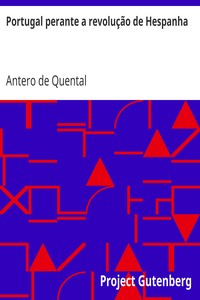
Portugal perante a revolução de Hespanha by Antero de Quental
Published in 1868, this isn't a novel or a dry historical account. It's a political pamphlet, a fiery essay written in real-time as history unfolded. Antero de Quental, a leading intellectual of Portugal's 'Generation of 1870,' uses the seismic events in Spain as a catalyst to examine his own country's soul.
The Story
There isn't a traditional plot with characters. The 'story' is the revolution itself. In September 1868, a military uprising in Spain deposed Queen Isabella II. This 'Glorious Revolution' promised democracy, liberty, and modernization. Quental seizes this moment. He breaks down what happened in Spain, why it mattered, and then turns the spotlight directly on Portugal. He asks uncomfortable questions: Why is Portugal stuck in the past while Spain charges ahead? Are our own institutions—monarchy, church, social hierarchy—holding us back? He paints a stark picture of a Portugal asleep at the wheel, risking being left behind in the dust of progress. The central drama is the tension between two nations and the frantic self-examination it triggers in one of them.
Why You Should Read It
What's amazing is how immediate it feels. You're not reading about history from a distance; you're in the room with a brilliant, anxious mind as he processes breaking news. Quental's passion is contagious. He isn't just analyzing Spain; he's desperately trying to wake Portugal up. His arguments about national identity, the fear of change, and the burden of tradition are surprisingly timeless. You can feel his frustration with political apathy and his hopeful, almost desperate, belief that Portugal could choose a better path. It's a short, potent shot of intellectual adrenaline.
Final Verdict
This book is perfect for history buffs who want to get beyond kings and battles and into the minds of the people living through upheaval. It's also great for anyone interested in political philosophy or the eternal struggle between old ways and new ideas. Don't expect a neat narrative—expect a provocative, challenging, and brilliantly argued essay that shows how a crisis abroad can force a nation to look in the mirror. It's a compelling piece of 19th-century thought that still has a lot to say about how countries define themselves in times of change.
No rights are reserved for this publication. Knowledge should be free and accessible.
Linda Hernandez
1 year agoIt’s rare to find such a well-structured narrative nowadays, the objective evaluation of the pros and cons is very refreshing. It’s hard to find this much value in a single source these days.
Linda Wilson
7 months agoThe digital formatting makes it very easy to navigate.
David Gonzalez
7 months agoI've been looking for a reliable source on this topic, and the wealth of information provided exceeds the average market standard. I am looking forward to the author's next publication.
Kimberly Gonzalez
10 months agoI was skeptical about the depth of this book at first, but the visual layout and supporting data make the reading experience very smooth. I appreciate the effort that went into this curation.





James Johnson
2 months agoI've been looking for a reliable source on this topic, and the formatting on mobile devices is surprisingly crisp and clear. It’s a comprehensive resource that doesn't feel bloated.